Why a Clutter‑Free Home Matters
If your home constantly feels messy, it’s not “just stuff.” It impacts your mood, energy, and how you show up for work, family, and yourself. A clutter-free home is one of the simplest ways to create a calmer, more focused, more enjoyable life.
Stress, Mental Health, and a Clutter-Free Life
Clutter constantly “talks” to your brain:
- Every pile = a reminder of something undone
- Visual noise = mental noise
- Too much stuff = constant micro-stress
A clutter-free home supports better mental health because:
- Your brain has fewer things to process
- You feel more in control of your day
- You rest more deeply in a clean, calm space
You don’t need a Pinterest-perfect house. You just need less chaos in your line of sight.
Save Time and Reduce Decision Fatigue
An organized space is like a quiet assistant in the background, doing work for you.
Cluttered home:
- “Where are my keys?”
- “Did I already buy pasta?”
- “Which outfit should I wear?”
Organized home:
- You know where things live
- You buy fewer duplicates
- You make faster, easier choices
Decision fatigue drops when you’re not making tiny decisions all day about where things are, what to wear, or how to navigate piles of stuff.
| Situation | Cluttered Home | Clutter-Free Home |
|---|---|---|
| Getting out the door | Late, frustrated, scrambling | On time, calm, everything in one spot |
| Cooking dinner | Missing tools, crowded counters | Clear counters, tools easy to grab |
| Bedtime routine | Visual chaos, hard to unwind | Peaceful room, faster wind-down |
Better Family Dynamics and Relationships
Clutter doesn’t just sit there. It affects how people talk and react to each other.
- Fewer arguments about lost items
- Less resentment over “who does what”
- Clearer routines everyone can follow
A more organized home often means:
- More shared ownership: everyone knows where things go
- Less nagging: systems replace repeated reminders
- Easier for kids to help: clear bins, labels, and simple rules
A Calm, Welcoming, Peaceful Space
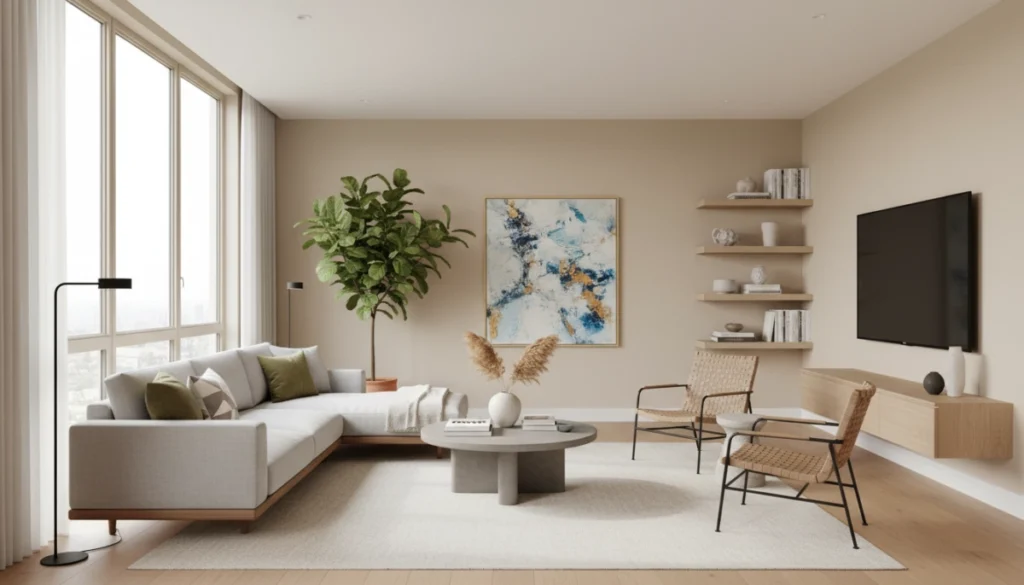
You feel different when you walk into a tidy room versus a cluttered one—and so do your guests.
A clutter-free home feels:
- More spacious, even if it’s small
- More peaceful, with less visual distraction
- More welcoming, because there’s room to breathe and move
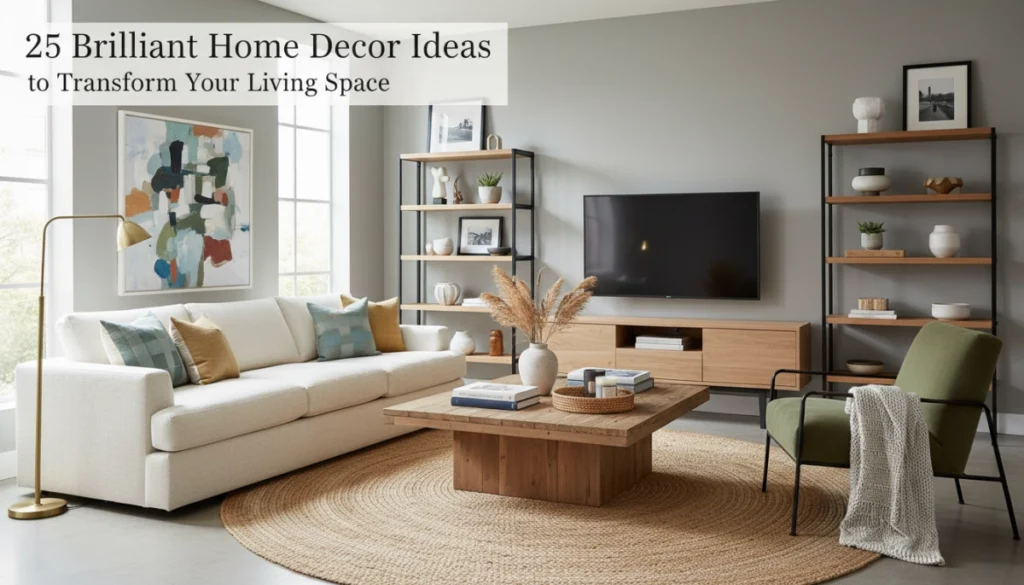
You don’t need fancy decor. A few clear surfaces and simple storage can make your space feel like a retreat instead of a storage unit.
Simple Habits Beat Perfection
You don’t need complex organizing systems or expensive products to declutter your home. You need small, repeatable habits.
Think:
- 5-minute resets instead of weekend marathons
- One-in, one-out instead of giant purges
- Clear “homes” for everyday items instead of rigid systems
Key idea:
A clutter-free life comes from simple, consistent habits, not perfection. You’re not trying to create a museum—you’re building a functional, stress-free living space you actually enjoy.
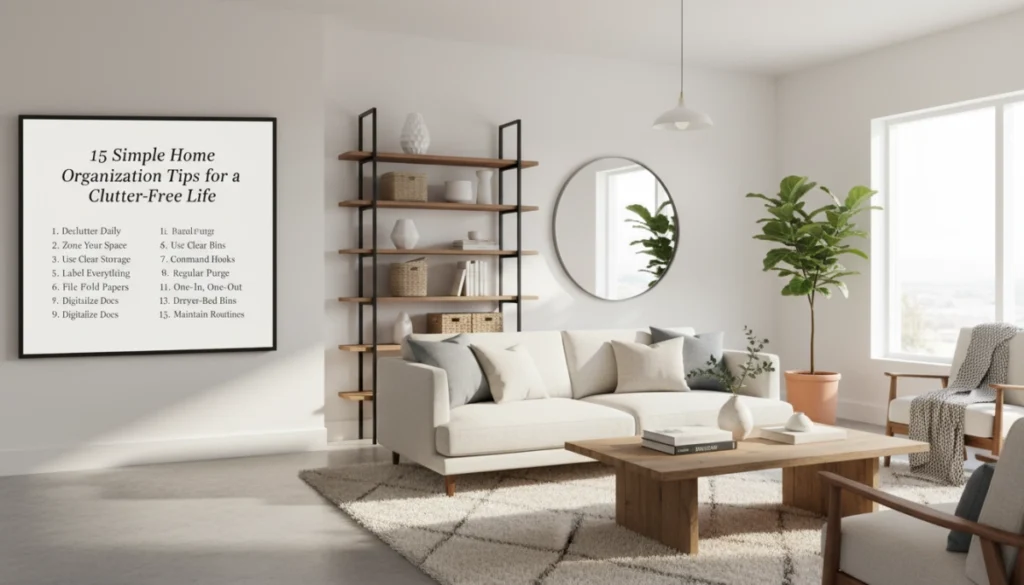
15 Simple Home Organization Tips for a Clutter-Free Life
These 15 simple home organization tips are built to work together so you can declutter your home without burning out. Think of them as a system, not a chore list:
- Some tips help you clear clutter fast (like the four-box method and the 20/20 rule).
- Others help you maintain an organized home (like daily 10-minute tidies, weekly reviews, and the one-in, one-out rule).
- A few focus on smart storage solutions for small spaces (vertical storage, hidden storage, multi-functional furniture).
- The rest focus on mindset and habits, so your clutter-free life actually lasts.
To use these home organization ideas without feeling overwhelmed, I keep it very simple:
- Start small, not “someday big.” Pick one tip that feels easiest and use it in one tiny area (a drawer, one shelf, one corner).
- Layer slowly. Once that feels natural, add another habit—like a daily 5–10 minute tidy or a drop zone by the door.
- Think progress, not perfection. You’re building daily organizing habits, not auditioning for a magazine shoot.
- Match your real life. If you’re a busy parent, renter, or working long hours, focus on quick wins and family-friendly organizing ideas that your kids and partner can follow too.
Used together, these clutter-free home tips help you create a stress-free living space that’s easier to clean, easier to live in, and actually supports your day—not the other way around.
Start Small to Build Momentum
Why one drawer or shelf is the best place to start
If your home feels out of control, start tiny. One drawer, one shelf, one corner. That’s it.
- A small space gives you a quick win, not burnout.
- You see the before and after in under 20–30 minutes.
- Your brain gets a hit of “this works,” which makes it easier to keep going and declutter your home step by step.
This is how I treat beginner home organizing: zero pressure, just clear one mini zone and move on.
How to pick your first small organizing project
Choose something:
- Visible – you see it every day.
- Annoying – it slows you down or stresses you out.
- Simple – no deep sentimental items yet.
Good starting points:
- A messy kitchen drawer you open every day
- A bathroom shelf crowded with products
- The entry table where mail and keys pile up
If you stand in a room and ask, “What bugs me most right now?” that’s your first simple home organization project.
Quick-win areas to tackle first
These spots give you fast, satisfying results and real-life impact:
-
Entry table
- Clear off old mail, random papers, and receipts.
- Keep only: keys, wallet, one small tray or basket.
- This supports better entryway organization and makes coming home feel calmer.
-
Nightstand
- Remove books you’re not actually reading, extra chargers, beauty products.
- Keep only nightly essentials: lamp, current book, glasses, water.
- This small reset supports better sleep and a more clutter-free bedroom.
-
Junk drawer
- Dump everything out.
- Sort into: keep, trash, move to another room.
- Use small bins or dividers so items have a clear home.
- This is a great beginner spot for simple decluttering methods.
How small wins build motivation to declutter your home
These tiny projects are how you build momentum and a clutter-free life:
- You see proof that 15–20 minutes can change a space.
- You feel less overwhelmed, so you’re more likely to try a new drawer or shelf tomorrow.
- You naturally start building daily organizing habits—like putting things back because you worked hard to give them a place.
Start small, finish fast, and repeat. That’s how you quietly transform a busy American home into a clutter-free, functional space without quitting halfway through.
Adopt the One-In, One-Out Rule
What the One-In, One-Out Rule Is
The one-in, one-out rule is simple:
Every time something new comes into your home, one similar item has to leave.
- Buy a new hoodie? One old hoodie goes.
- New mug from Target? One mug leaves the cabinet.
This keeps your stuff at a steady, manageable level and quietly reduces household clutter over time without massive cleanouts.
How to Apply It to Clothes, Toys, Decor, and Kitchen Items
Use this as a standing rule in the most clutter-prone categories:
- Clothes
- New shirt → donate/sell one old shirt.
- New pair of shoes → one pair out, no excuses.
- Toys (huge for families)
- New birthday toy → your kid picks one toy to donate.
- Holiday gifts → make space before the holiday.
- Decor
- New throw pillow, vase, or frame → something on that shelf or sofa goes.
- Keeps your space styled, not stuffed.
- Kitchen items
- New pan or gadget → remove the least used one.
- New mug or tumbler → one leaves the cabinet or travel cup drawer.
This turns decluttering your home into a built-in habit, not a once-a-year event.
Simple Ways to Stick to It as a Busy Parent or Renter
You don’t need a perfect system; you need a repeatable one:
- Create a “one-out” basket or bin
- Keep a donation bin in a closet, laundry room, or garage.
- When something new comes home, drop the “out” item in immediately.
- Make it a house rule
- Tell kids: “You want this new toy? Pick one to give away.”
- Partner buys new sneakers? One old pair goes into the donation bin.
- Tie it to shopping
- Before hitting Amazon or Target, scan your closet or kitchen and decide what’s leaving first.
- Use reminders
- Add a note on your phone: “One-in, one-out” for online orders and delivery days.
- Put a sticky note inside your closet door as a visual cue.
This is beginner home organizing that works even when life is busy.
When to Bend the Rule vs. When to Be Strict
You don’t need to be extreme, but you do need to be honest:
Be strict when:
- Your closets, drawers, or cabinets are already full.
- You live in a small apartment or have limited storage solutions for small spaces.
- You know a category is out of control (kids’ toys, mugs, leggings, shoes).
You can bend it when:
- You’re building a basic wardrobe or first kitchen and don’t have enough essentials yet.
- You’re replacing broken, worn-out items and still need a bit of backup.
- It’s a truly special, rare item (but not every sale counts as “special”).
If you bend the rule, balance it later:
Did two things come in with nothing going out? Then next time, go one-in, two-out.
Used consistently, the one-in, one-out rule becomes one of those simple home organization tips that quietly keeps your space clutter-free—even with kids, roommates, or a hectic schedule.
Create a Place for Everything
A clutter-free home starts with one rule: everything you own needs a home. When every item has a clear spot to “live,” you stop dropping things on counters, you lose less, and your daily tidying gets 10x easier.
Why “a home for everything” works
A simple “home base” system helps you:
- Reduce decision fatigue – You don’t have to think, “Where should this go?” every time.
- Cut visual clutter – Less random stuff on surfaces = calmer, more minimalist home living.
- Maintain an organized home – Putting things away takes seconds when the spot is obvious.
Everyday essentials: assign logical spots
Keep high-use items where you naturally use or drop them. For example:
- Keys & wallets: Small tray, hook, or bowl by the entry (no more “Where are my keys?”).
- Mail & papers: One vertical file or wall organizer for “To handle this week.”
- Chargers & electronics: A single charging station with a bin or drawer for cords.
- Bags & backpacks: Hooks by the door or a cubby per person.
Stick to this rule: same item, same spot, every time.
Room-by-room “home” ideas
Use simple home organization tips by room:
-
Entryway
- Wall hooks for coats and bags
- Shoe rack or basket for daily shoes
- Small tray for keys, sunglasses, and access cards
-
Kitchen
- One drawer for utensils, one for gadgets
- Bin for snacks, bin for lunch supplies
- Basket for water bottles and travel mugs
-
Living room
- Basket for remotes and game controllers
- Bin for blankets, one for kids’ toys
- Magazine/file holder for mail or school papers
-
Bedroom
- Nightstand drawer or tray for glasses, book, charger
- Hamper for dirty clothes, bin for clean-but-rewear items
- Single jewelry tray or box instead of random dishes
-
Bathroom
- Caddy for daily skincare
- Basket for backup toiletries (extras only)
- Drawer dividers for makeup, razors, and hair ties
These simple decluttering methods keep every room on a clear system, not random habits.
Labels and containers (without overcomplicating it)
You don’t need fancy Pinterest-level setups. Stick to basic, functional home storage:
- Use bins, baskets, and clear containers to define “homes” on shelves and in cabinets.
- Add simple labels so everyone in the family knows where things go:
- “SNACKS,” “SCHOOL SUPPLIES,” “FIRST AID,” “CHARGERS,” “CLEANING,” “TOYS.”
- Go low-cost:
- Masking tape + marker
- Printable labels
- Clip-on tags for baskets
The goal: fast to understand, fast to maintain. If a bin or label makes it easier to put stuff back in seconds, it’s doing its job.
By creating a place for everything, you turn daily chaos into a repeatable system. That’s how you declutter your home and actually keep it that way.
Implement Daily 5–10 Minute Tidies
Why short daily tidies work
I treat 5–10 minute tidies like brushing my teeth—small, daily habits that keep things from ever getting out of control. These quick resets:
- Stop clutter before it piles up
- Make weekly cleaning faster and easier
- Reduce visual stress so your home feels calmer
- Help you maintain an organized home without marathon decluttering sessions
You don’t need a big block of time. You just need short, focused bursts.
Best times for a quick reset
Pick 1–3 times a day that already exist in your routine:
- Morning reset (5 minutes)
- Make the bed
- Clear nightstands
- Put dirty clothes in the hamper
- After-dinner reset (5–10 minutes)
- Clear and wipe kitchen counters
- Load or start the dishwasher
- Put away food and mail
- Before-bed reset (5–10 minutes)
- Pick up living room clutter
- Put shoes, coats, and bags back in their spots
- Do a quick walk-through with a laundry basket for “out of place” items
Set a timer, move fast, and stop when it goes off. That’s the whole system.
High-impact areas to hit daily
For a clutter-free home and a more stress-free living space, focus on the spots you see and use the most:
- Kitchen counters – no random mail, toys, or packages sitting all day
- Sink and stove area – dishes washed or in the dishwasher, surfaces wiped
- Living room – blankets folded, remotes in a tray, toys in a bin
- Entryway – shoes in a basket, coats on hooks, keys in a dish, bags on a hook
These high-traffic zones make your whole home look either “chaotic” or “under control,” so they’re worth the daily attention.
Simple family routines that actually stick
To make daily organizing habits realistic, I build in simple, repeatable tasks for everyone:
- For kids
- “Toys back in the bin before screen time”
- “Backpack emptied and hung up after school”
- “Dirty clothes straight into the hamper at night”
- For partners
- Keys, wallet, and phone always in the same drop zone
- Mail sorted immediately: recycle, shred, or action pile
- Shoes go in one specific basket or shelf, not the floor
Keep the rules easy and consistent. Use one basket per person or one bin per category (toys, mail, pet gear) so it’s obvious where things go.
These simple home organization tips turn tidying into a quick habit, not a big chore—and that’s how you quietly build a clutter-free life.
Use the Four-Box Decluttering Method
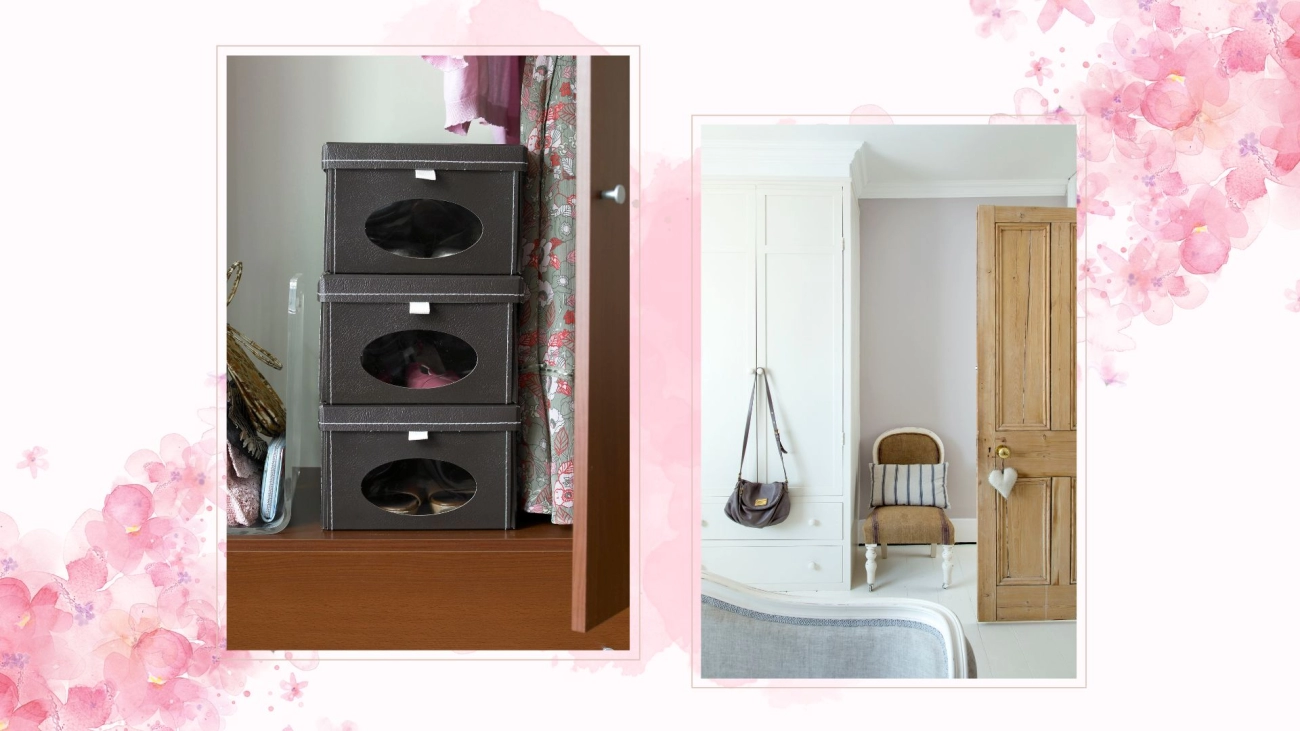
If you want to declutter your home without overthinking every item, the four-box decluttering method is one of the simplest, most practical simple home organization tips you can use.
How the four-box method works
Grab four boxes, bags, or baskets and label them clearly:
- Keep
- Donate
- Sell
- Trash
Every single item you touch goes into one of these four. No “maybe” pile. This structure cuts decision fatigue and keeps you moving.
Step-by-step: Use it in any room
You can use this in a bedroom, kitchen, bathroom, garage—anywhere you need simple decluttering methods:
- Pick one small area
A single shelf, drawer, or corner. Don’t pull apart the whole room at once. - Empty the space
Take everything out so you see the full picture of your clutter. - Sort item by item
- If you use it and love it → Keep
- If it’s in good shape but you don’t use it → Donate or Sell
- If it’s broken, stained, or expired → Trash
- Put back only what’s staying
Return Keep items in a neat, logical way that supports a clutter-free home. - Move to the next small area
Repeat until the room is done.
Make fast decisions (and avoid overthinking)
To keep this a stress-free, clutter-free home tip, set clear rules:
- Use a timer: 15–20 minutes per session. Work fast.
- Ask simple questions:
- Have I used this in the last year?
- Would I buy this again today?
- Does this fit my current lifestyle or home?
- Skip the guilt: Money spent in the past is gone. Keeping unused stuff just adds mental clutter.
- Handle sentimental items last so they don’t slow you down.
If you’re stuck, that usually means it’s a Donate or Sell item—not a Keep.
Prevent donation and sell piles from becoming new clutter
The four-box method only works if the stuff actually leaves your house. Don’t let donation and sell piles camp out in your hallway for weeks.
Here’s how to keep your home organization ideas from backfiring:
- Set a deadline
- Donation box: drop off within 7 days
- Sell box: list items online within 7–10 days
- Pre-plan where they go
- Donations: local thrift store, charity drop box, church, school fundraiser
- Sell: Facebook Marketplace, OfferUp, Poshmark, neighborhood group
- Create a “departure zone”
Keep donation and sell boxes by the front door, in the garage, or in your car trunk so they’re ready to go. - Be realistic
If you haven’t listed sell items by your deadline, turn them into Donate and move on. Your space is worth more than a maybe $10.
Used consistently, the four-box decluttering method is a powerful way to reduce household clutter, build momentum, and create a clutter-free life without complicated systems.
Declutter by Category, Not Room
Decluttering by category is one of the simplest home organization ideas I rely on. Instead of bouncing room to room, I tackle one type of item across the whole house. It makes every other simple decluttering method way more effective.
Why decluttering by category works
When you declutter by category, not room, you:
- See the full picture – You finally see how much you actually own.
- Spot duplicates fast – Ten black t‑shirts, three can openers, four sets of measuring cups.
- Define your real needs – It’s easier to ask, “How many do I actually use?” when you see everything at once.
- Make clearer decisions – Comparing like with like cuts down on overthinking and “maybe” piles.
This approach helps you declutter your home faster and with fewer regrets.
Key categories to tackle first
Keep it simple. Start with categories that are easier and less emotional:
- Clothes – Everyday wear, workout gear, jackets, shoes.
- Books – Novels, cookbooks, kids’ books, old textbooks.
- Papers – Mail, bills, manuals, school papers, receipts.
- Bathroom items – Skincare, makeup, hair products, extra toiletries.
- Toys – Stuffed animals, blocks, board games, craft kits.
These are high-impact categories for a clutter-free home and work well for beginner home organizing.
How to gather items into one spot
To make this method work, you need everything from that category in front of you:
- Choose one category only. For example: “Today is clothes.”
- Collect from every room. Closets, drawers, laundry room, storage bins, garage—everything.
- Use one central spot. Bed, dining table, or a clear floor area.
- Sort fast. Make quick decisions instead of drifting into other tasks.
Yes, it looks messy for a bit. That’s normal. You’re pulling the clutter out so you can control it.
How this method clarifies your real needs
When you see an entire category together, it gets very real, very quickly:
- You see how much you truly use versus what just sits there.
- You notice patterns (you never wear dress shirts, the kids only play with 20% of the toys).
- You can decide on intentional limits:
- “I keep 10 everyday tees.”
- “We keep board games that get played at least once a month.”
- You can set simple rules going forward, like the one in, one out rule for clothes or toys.
This category-first approach builds a more minimalist home living style without forcing you to be extreme. It makes your daily organizing habits easier and helps you create a truly clutter-free life that fits real American family routines.
Maximize Vertical and Hidden Storage
If you live in a small apartment or a busy family home, maximizing vertical and hidden storage is one of the fastest ways to create a clutter-free home without adding more furniture.
Vertical storage ideas for small spaces
Use your wall space like extra square footage:
- Wall shelves:
- Above the sofa, desk, toilet, or washer/dryer
- Great for books, baskets, and decor instead of crowding surfaces
- Wall hooks & peg rails:
- Entryway: bags, coats, backpacks, dog leashes
- Bedroom: hats, robes, hoodies
- Garage: tools and sports gear
- Over-the-door racks:
- Bathroom: towels, hair tools, cleaning supplies
- Bedroom closet: shoes, scarves, accessories
- Pantry door: snacks, foil, wraps, spices
These simple vertical storage shelves free up floors and counters so your space feels open and calm.
Hidden storage tips that actually work
Think “out of sight, still easy to reach”:
- Under-bed storage ideas:
- Low rolling bins for off-season clothes, shoes, extra bedding
- Zip fabric bags for blankets and guest linens
- Inside cabinets and closets:
- Use stackable bins for cleaning supplies, snacks, and toiletries
- Add shelf risers to double vertical space
- Door-mounted racks for lids, spices, and small items
- Furniture with hidden storage:
- Storage ottomans for blankets, games, toys
- Benches with cubbies by the entry for shoes and bags
These functional home storage moves are perfect storage solutions for small spaces and busy U.S. households.
Keep storage simple, not overloaded
It’s easy to turn storage into another form of clutter. To avoid that:
- Aim to keep every bin or shelf no more than 80–90% full
- Store only what you actually use in the last year (or last season)
- Use bigger, fewer containers rather than tons of tiny ones
- Avoid stacking so high you can’t reach things without a step stool
If you can’t get an item in or out without moving three other things, the system is overloaded.
Balance access with a clean, clutter-free look
The goal is a clutter-free home that still works for real life:
- Keep daily-use items (keys, purse, kids’ backpacks, favorite pans) at eye level and easy to grab
- Move backups and rarely used items (holiday decor, extra bedding, bulk paper towels) higher or under the bed
- Use closed baskets, bins, and doors for the visual clutter: cords, toys, cleaning products
- Use open shelves for things that look tidy: books, labeled baskets, a few decor pieces
When you maximize vertical and hidden storage the right way, you reduce household clutter without sacrificing comfort, and your home feels lighter the minute you walk in.
Label Everything for a Clutter-Free Home
Why labeling keeps your home organized long-term
Labeling is one of the simplest home organization ideas that actually sticks. When everything is clearly labeled:
- Everyone knows where things go, so you maintain an organized home without nagging.
- You make faster decisions and reduce daily decision fatigue.
- It’s easier to spot clutter and duplicates because every item has a “job” and a labeled home.
Labels turn your systems into habits, not one-time projects.
Where to use labels in a clutter-free home
Use labels anywhere stuff tends to drift:
- Bins & baskets: snacks, cords, cleaning supplies, seasonal decor.
- Shelves: books, office supplies, pantry zones, linen closet.
- Pantry: baking, breakfast, snacks, pasta, canned goods, kids’ snacks.
- Kids’ rooms: toys, Legos, dolls, art supplies, puzzles, out-of-season clothes.
- Entryway drop zones: keys, mail, returns, backpacks, sports gear.
Label the location, not the item: “Snacks,” not “Chips.”
Simple labeling systems that work for the whole family
Keep your simple home organization tips truly simple:
- Use clear, short words: “Towels,” “Tools,” “Crafts,” “Bathroom Backstock.”
- For kids, combine words + icons (toy, book, car, block).
- Color-code by person or category:
- Blue = Dad, Pink = Mom, Green = Kids
- Red = Cleaning, Yellow = Office, Green = Pantry
- Stick the label on the front, at eye level so it’s impossible to miss.
If someone has to ask, “Where does this go?”—you probably need a label.
Low-cost labeling options on a budget
You don’t need fancy gear to follow these clutter-free home tips:
- Painter’s tape + Sharpie (cheap, removable, renter-friendly).
- Printable labels from a basic home printer.
- Index cards or cardstock clipped or taped to baskets.
- Chalkboard or dry-erase labels for changing categories.
Start with high-traffic spots—pantry, entryway, bathroom, kids’ spaces—so your daily organizing habits feel easier right away.
Establish Drop Zones for a Clutter-Free Home
A simple “drop zone” is one of the easiest simple home organization tips I use to tame daily clutter. It’s a small, defined spot where everyday items land the second you walk in, so they don’t explode all over the house.
What Is a Drop Zone?
A drop zone is a designated landing spot for things you touch every day:
- Keys
- Wallets
- Bags and backpacks
- Mail and packages
- Sunglasses, headphones, work badges
When everything has a home the moment you walk in, you reduce household clutter, save time, and stop the constant “Where are my keys?” scramble.
Entryway Drop Zone Ideas
Your entryway is prime real estate for a family-friendly organizing idea. Keep it tight and practical:
- Wall hooks or a small rack for coats, bags, and backpacks
- Shallow tray or bowl for keys, wallets, and sunglasses
- Small bin or wall file for incoming mail and school papers
- Shoe rack or mat for 2–3 pairs of everyday shoes per person
- Bench with storage (perfect multi-functional furniture) for shoes, hats, or dog leashes
Keep it simple: one surface, one tray, one hook per person. That’s it.
Mini Drop Zones in Key Rooms
To maintain a clutter-free home in a busy US household, I like small, intentional drop zones in a few hot spots:
Kitchen:
- Counter tray for mail, coupons, and keys (emptied once a day)
- Small bin for lunchboxes and water bottles
- Wall file for school forms and bills
Hallway:
- Narrow console table with a small bowl and one catch-all basket
- Hooks for dog leashes, hats, or workout bags
Bedroom:
- Nightstand tray for glasses, watch, phone, and charger
- Basket for throw pillows and blankets so they don’t live on the floor
These mini zones support your daily organizing habits without taking over the room.
Rules to Keep Drop Zones from Becoming Junk Piles
Drop zones work only if they have clear rules and boundaries. Here’s how I manage mine:
- Set a physical limit:
- One tray, one bin, one row of hooks. If it’s full, something has to go.
- Daily 2-minute reset:
- Put away anything that doesn’t belong (toys back to kids’ rooms, tools back to the garage, etc.).
- No long-term storage:
- Drop zones are for items you use every day or every week, not “someday” stuff.
- Sort mail on the spot:
- Trash/recycle junk mail immediately. Bills go in a labeled folder or bin.
- Use labels:
- Label baskets: “Mail,” “Keys,” “Backpacks,” “Shoes” so everyone in the family knows where things go.
When you treat your drop zones as high-traffic tools, not mini storage units, they’ll keep your home organized instead of adding more clutter.
Digitize What You Can
Going digital is one of the simplest home organization ideas if you’re drowning in paper clutter. I treat my phone and laptop like extra filing cabinets, so my counters and drawers stay clear.
What Paper Clutter You Can Digitize
You can safely digitize most everyday paper and reduce household clutter fast:
- Bills & statements – utilities, bank statements, credit card bills
- Receipts – for taxes, warranties, business, and big purchases
- School papers – newsletters, schedules, lunch menus, reminders
- Forms & documents – leases, insurance, medical summaries, tax docs
- Keepsakes – kids’ artwork, cards, letters, event programs
- Owner’s manuals – most are online; scan or just save the link
This clears your counters, files, and “paper piles” so your home feels more like a stress-free living space.
Easy Tools & Apps for Scanning
You don’t need fancy gear. For most U.S. households, this is enough:
- Phone camera + app
- iPhone: built-in Notes scan
- Android: Google Drive scan
- Apps: Adobe Scan, Microsoft Lens, CamScanner
- Cloud storage
- Google Drive, iCloud Drive, Dropbox, OneDrive
- Desktop scanner (optional)
- Helpful if you have piles of old files or run a home business
I keep a small “To Scan” tray near my drop zone, then batch-scan once a week as part of my easy home tidying tips.
How to Organize Digital Files
If your digital files are a mess, you’ll still feel cluttered. Keep it simple and consistent:
- Use clear main folders:
- Home, Finance, Medical, Kids, Work, Taxes, Keepsakes
- Use subfolders by year or person:
- Kids > Emma > School 2026
- Finance > Bank > 2026
- Use simple file names:
- 2026-01-10_Electric_Bill.pdf
- 2026_Tax_Return.pdf
- Back up automatically:
- Turn on auto-sync to cloud + an external drive if possible
The goal: when you need something, you can find it in three clicks or less.
What to Keep Physical vs. What to Let Go
You don’t need to keep everything, but some things should stay on paper. A simple rule that works for most U.S. families:
Usually keep physical:
- Birth, marriage, and death certificates
- Social Security cards, passports, immigration documents
- Property deeds, car titles, loan contracts
- Original wills, powers of attorney, trust documents
- A few truly special keepsakes (one box per person is enough)
Usually safe to digitize and toss:
- Paid utility bills and bank statements (if you have online access)
- Everyday receipts (unless needed for taxes/warranty)
- School flyers, event reminders, schedules
- Owner’s manuals (if available online)
- Most general mail and notices
By digitizing what you can, you declutter your home, cut down on paper stress, and make it easier to maintain an organized home without needing more bulky storage.
Follow the 20/20 Rule for Hesitation
What the 20/20 Decluttering Rule Is
When I’m stuck on an item, I use the 20/20 decluttering rule:
If you can replace it for under $20 and in under 20 minutes, you can let it go.
Use this rule when you:
- Keep something “just in case”
- Haven’t used it in a year (or more)
- Feel guilty tossing it, but know you don’t actually use it
It’s a simple filter that reduces overthinking and keeps a clutter-free home realistic.
How It Helps You Let Go of “Just in Case” Items
The 20/20 rule is powerful because it:
- Cuts fear: You know you can replace it quickly and cheaply if you ever truly need it
- Prevents storage overload: You stop dedicating space to low-value, low-use items
- Protects your time: Less stuff means faster cleaning and easier daily organizing habits
Instead of asking “What if I need this someday?” ask:
“Would I actually spend $20 and 20 minutes to get this again?”
If the answer is no, it’s safe to let it go.
Easy Examples You Can Release Using the 20/20 Rule
Here are common “just in case” things in U.S. homes that usually pass the 20/20 test:
- Extra cheap kitchen gadgets and duplicates
- Old water bottles, coffee mugs, plastic cups from events
- Random cords and chargers with no matching device
- Free tote bags, swag, conference goodies
- Stretched-out towels, extra bedding you never use
- Old beauty products, hair tools you don’t reach for
- Outdated phone cases, accessories, cheap decor
These things eat up functional home storage that could go to items you actually use.
Combine the 20/20 Rule with Other Simple Decluttering Methods
Use the 20/20 rule as a support tool, not the only system:
- During the four-box decluttering method (Keep / Donate / Sell / Trash),
use 20/20 on any “maybe” items to make faster decisions. - When you declutter by category (clothes, kitchen, office supplies),
apply 20/20 to duplicates and low-value extras. - Pair it with your daily 5–10 minute tidy to quickly clear “I’m not sure” items from counters, drawers, and entryway drop zones.
The goal is simple: keep what you love and actually use, release what you wouldn’t pay to replace, and let these simple decluttering methods support a calm, clutter-free life.
Organize Room by Room Strategically
Choose the first room for maximum impact
When I organize room by room, I always start where I’ll feel the win fast. For most homes in the U.S., that’s one of these:
- Entryway – You see it first and last every day.
- Kitchen – Daily traffic, constant mess, big impact.
- Bedroom – Sleep and stress are directly tied to how calm this space feels.
Ask yourself: Where does clutter stress me out the most? Start there. That’s how you get a clutter-free home without burning out.
Room-by-room organization priorities
Here’s how I prioritize simple home organization tips by space:
Entryway (entryway organization tips)
Focus on stuff that lands here every day:
- Hooks or a rack for coats and bags
- Tray or bowl for keys and wallet
- Small bin for mail (inbox only, not storage)
- Simple shoe rack or mat for daily shoes
Kitchen (kitchen organization hacks)
This is the main clutter magnet, so keep it functional:
- Clear countertops (only daily-use items stay out)
- One organized “coffee/snack zone”
- Drawer dividers for utensils
- A clear spot for lunchboxes and water bottles
Bedroom (bedroom decluttering tips)
You want calm, not chaos:
- Clear nightstands (lamp + 1–2 essentials)
- Use under-bed storage for off-season clothes
- Limit decor to a few things you actually love
- Keep dirty laundry in one closed hamper, not piles
Bathroom (bathroom storage solutions)
Small room, easy wins:
- Use bins under the sink for categories (hair, skincare, backup)
- One small tray or caddy on the counter
- Toss expired products regularly
- Hooks for towels instead of overcrowded bars
Quick wins in each room
To declutter your home without feeling overwhelmed, start with one quick win per room:
- Entryway: Clear the floor, set up a key tray, hang a few hooks.
- Kitchen: Empty and reset just one counter or one drawer.
- Bedroom: Make the bed, clear the top of your dresser.
- Bathroom: Toss trash, old products, and clear the sink area.
These easy home tidying tips build momentum fast and support a clutter-free life.
Schedule realistic sessions around a busy life
If you’re a busy parent, renter, or working long hours, home organization has to fit real life:
- 10–15 minutes on weekdays
- Example: Nightstand Monday, junk drawer Tuesday, under-sink Wednesday.
- 1 focused room block on weekends (30–60 minutes)
- Pick one room and one goal, like “entryway shoes + hooks” or “bedroom closet top shelf.”
- Use timers:
- Set a 15-minute timer and stop when it goes off. No perfection, just progress.
- Pair with existing habits:
- Declutter kitchen for 10 minutes after dinner.
- Tidy bedroom for 5 minutes before bed.
With this room by room organization approach, you reduce household clutter in chunks, keep your home functional, and make a clutter-free home realistic—even with a full schedule.
Incorporate Multi-Functional Furniture for a Clutter-Free Home
Multi-functional furniture is one of the easiest simple home organization tips to cut clutter fast, especially in small U.S. apartments and busy family homes.
Benefits of Furniture With Built-In Storage
Multi-use pieces instantly reduce household clutter and free up floor space:
| Benefit | What It Does for You |
|---|---|
| Hidden storage | Keeps toys, blankets, and gear out of sight |
| Fewer furniture pieces | Less visual noise, more calm, open space |
| Better traffic flow | Easier to walk, clean, and tidy |
| Quick cleanups | Toss items in, close the lid, you’re done |
This is a simple way to get a clutter-free home without adding complicated systems.
Examples of Multi-Functional Storage Furniture
Work these storage solutions for small spaces into your home:
-
Storage ottomans
- Hide blankets, games, remotes, kids’ toys
- Use as a coffee table, footrest, or extra seating
-
Beds with drawers or lift-up storage
- Store off-season clothes, extra bedding, suitcases
- Great under bed storage ideas for small bedrooms
-
Benches with cubbies or baskets
- Perfect for entryway organization tips: shoes, bags, backpacks
- Works in mudrooms, hallways, or at the foot of the bed
-
Nesting tables
- Pull out when guests come, tuck away when not needed
- Keep the living room looking clean and simple
How to Choose Pieces That Actually Work
When I choose multi-functional furniture for my own spaces, I keep it practical:
-
Match your real habits
- If you drop bags at the door, add a bench with storage there
- If kids play in the living room, choose a storage ottoman over a glass table
-
Stick to your style
- Neutral fabrics and simple lines = less visual clutter
- One style (modern, farmhouse, minimal) across the room looks calmer
-
Make it family-friendly
- Soft edges for kids and pets
- Easy-open lids and drawers so everyone can help tidy
Use Multi-Functional Furniture to Reduce Visual Clutter
The goal is functional home storage that you barely notice:
- Swap extra side tables and random baskets for one or two smart pieces
- Choose closed storage (lids, doors, drawers) to hide visual noise
- Use each piece as a “home” for specific categories:
- Ottoman = games and remotes
- Bench = shoes and bags
- Bed drawers = linens and off-season clothes
Done right, multi-functional furniture lets you declutter your home, own fewer pieces, and keep a laid-back, clutter-free life without organizing for hours.
Maintain with weekly reviews
Staying clutter-free long-term comes down to weekly organization check-ins. A 15–30 minute review keeps your systems honest, your stuff under control, and your life a lot less stressful.
Why weekly reviews stop clutter from coming back
A simple weekly review helps you:
- Catch clutter early before it piles up into a weekend project
- Spot “hot spots” that always attract stuff (entryway table, kitchen counter, bedroom chair)
- Notice what’s not working in your home organization ideas and fix it fast
- Stay in a habit-based home organization mindset instead of crisis cleaning
Think of it like a quick oil change for your home. Small, regular maintenance beats big, painful cleanups.
A simple 15–30 minute weekly reset
Pick one set time each week (Sunday afternoon, Friday night, whatever fits your schedule) and run this quick routine:
-
5 minutes – Surface reset
- Clear kitchen counters
- Pick up living room clutter
- Reset the entryway drop zone (shoes, keys, mail)
-
5–10 minutes – Hot spot sweep
- Walk room by room and grab anything out of place
- Toss obvious trash and recycling
- Return items to their “home” using your simple home organization tips
-
5–10 minutes – Mini declutter
- Choose one small area: a drawer, shelf, bin, or basket
- Use a four-box decluttering method (Keep, Donate, Sell, Trash) if needed
- Apply the one in, one out rule to clothes, toys, or decor you noticed piling up
You keep it short on purpose. These are easy home tidying tips you can actually stick with, even on a busy week.
What to look for during your weekly review
During your check-in, scan for:
-
Hot spots
- Places that are always messy
- Ask: “Do we need a bin, hook, or label here?”
-
Overstuffed areas
- Drawers that don’t close, baskets that are overflowing, jammed closets
- Use simple decluttering methods: pull a few items to donate or trash immediately
-
Unused items
- Stuff you keep moving but never use
- Apply the 20/20 decluttering rule: if you can replace it for under $20 in under 20 minutes, it’s safe to let go
These quick checks help you maintain an organized home without starting from zero every month.
Adjusting your systems as life changes
Your home isn’t static. Schedules, kids’ activities, and seasons change, so your functional home storage needs to flex too:
-
New sport or hobby?
- Add a drop zone basket or hook for that gear near the door.
-
No one uses a bin or drawer as intended?
- Move it to a more logical spot or relabel it so it matches how your family actually lives.
-
Kids growing, work-from-home changes, or a new pet?
- Shift storage solutions for small spaces, like vertical storage shelves or under-bed storage ideas, to where they’ll actually get used.
Weekly reviews keep your clutter-free home tips realistic and family-friendly. You’re not chasing perfection—you’re running a simple system that supports a clutter-free life in real, everyday American homes.
Cultivate a Mindset Shift for a Clutter‑Free Life
From “More Stuff” to “Enough”
If I want a truly clutter‑free home, I have to stop chasing “more” and start choosing “enough.”
That means asking before I buy or keep anything:
- Do I use this often enough to justify the space?
- Would I buy this again today at full price?
- Is this adding to my stress-free living space or my stress?
Minimalist home living doesn’t mean owning almost nothing. It means owning what actually serves my life—my work, my family, my routines—not just what fits on sale in my cart.
Gratitude for What You Keep
A big mindset shift is focusing on gratitude instead of scarcity:
- When I declutter my home, I remind myself:
“I’m not losing things. I’m gaining space, time, and calm.” - I notice how much easier it is to clean, find things, and relax.
- I treat the items I keep like they matter—better storage, better care, less waste.
This gratitude mindset makes it easier to maintain an organized home because I respect the space I’ve created.
Handling Guilt, Sentimental Clutter, and Fear
Most U.S. homes are packed with guilt items and “just in case” stuff:
- Guilt items: gifts I never liked, expensive buys I don’t use
- Reminder: The money is already gone. Keeping clutter doesn’t get it back.
- I keep the lesson, not the item.
- Sentimental clutter: kids’ art, old cards, keepsakes
- I save a small, curated box of the best pieces.
- I take photos of bulky items and let the physical thing go.
- Fear of letting go: “What if I need this one day?”
- I use the 20/20 decluttering rule in my mindset:
If I can replace it for under $20 in under 20 minutes, I don’t let it control my space.
- I use the 20/20 decluttering rule in my mindset:
Make Organizing Part of Who You Are
To keep a clutter-free home long-term, I treat simple daily organizing habits as part of my identity, not as a project:
- “I’m someone who puts things back where they belong.”
- “I’m someone who does a daily 5–10 minute tidy.”
- “I’m someone who doesn’t keep what I don’t use or love.”
A few habit anchors that work well in everyday American life:
- After work: drop mail in the same bin, keys in the same spot.
- After dinner: 5-minute kitchen reset—counters clear, dishes handled.
- Before bed: quick living room and entryway tidy.
The mindset shift is this:
My home should support my life, not drain it.
Once I believe that, decluttering and simple home organization tips stop feeling like chores and start feeling like self-respect.
Common Home Organization Mistakes to Avoid
1. Buying organizers before you declutter
One of the biggest home organization mistakes is shopping first and sorting later.
- Why it backfires:
- You buy the wrong size bins and baskets.
- You end up organizing clutter instead of removing it.
- Extra organizers become more clutter.
Do this instead:
Declutter your home first, then measure your shelves, drawers, and closets. After that, choose simple storage solutions that actually match what’s left.
2. Trying to declutter the whole house in one weekend
A full-house makeover in two days sounds great, but for most of us in the U.S. with busy work and family schedules, it’s not realistic.
- You burn out halfway through.
- Rooms get messier before they get better.
- You stop, feel defeated, and avoid restarting.
Better approach:
Use simple decluttering methods like the four-box decluttering method and a daily 10-minute tidy. Work room by room or category by category, not all at once.
3. Letting “maybe” and sentimental items slow you down
“Maybe I’ll use this someday” and “But this was a gift” are clutter traps.
- “Maybe” items keep you stuck in indecision.
- Sentimental clutter takes up space you need for your real life.
- You waste time shuffling the same items around.
What helps:
- Create a small “maybe” box with a clear deadline (60–90 days).
- Use rules like “If I wouldn’t buy it again, it can go.”
- For sentimental items, keep a few meaningful pieces, not every single thing.
4. Perfectionism that makes you quit
Wanting a Pinterest-perfect, minimalist home can quietly kill your progress.
- You feel like if it’s not perfect, it’s not worth doing.
- You put off small steps because they “won’t be enough.”
- You compare your home to others instead of your own starting point.
Shift your mindset:
- Aim for “better, not perfect.”
- Focus on function first, aesthetics second.
- Celebrate every drawer, shelf, or surface you improve.
Daily organizing habits beat one-time, perfect makeovers every time.
5. How to restart when you’ve fallen off your routine
Everyone falls off their home organization routine—especially busy parents, renters, and anyone juggling work, kids, and life.
Here’s how I reset fast:
- Pick one small space: a nightstand, bathroom drawer, or entry table.
- Set a 10–15 minute timer and use the four-box method: Keep, Donate, Sell, Trash.
- Do a quick daily reset in high-traffic zones: kitchen counters, living room, entryway.
- Remove donation bags from the house within 24–48 hours so they don’t become new clutter.
You don’t need a fresh month or a free weekend to restart. You just need one small win today. That’s how you build a clutter-free life that actually lasts.
How Lalulu Helps You Stay Clutter‑Free
Simple Lalulu storage solutions that actually work
I design Lalulu products to solve real, everyday problems in U.S. homes—small apartments, busy family houses, and everything in between. The goal is a clutter-free home with fewer decisions and less stress, using just a few smart tools.
Types of Lalulu products for a clutter-free home
Lalulu focuses on simple, functional home organization ideas:
- Bins & baskets – for toys, pantry items, linens, cleaning supplies
- Drawer dividers – for kitchen utensils, bathroom drawers, office supplies
- Shelf & closet organizers – for clothes, bags, and shoes
- Labels & label holders – for bins, baskets, and shelves so everyone knows where things go
Everything is designed to support simple home organization tips and daily organizing habits, not fight them.
Match Lalulu to each room
I always think room by room so you can reduce household clutter without overbuying:
- Entryway: labeled baskets for shoes, a small bin for keys/mail, hooks for bags
- Kitchen: clear pantry bins, turntables, drawer dividers for utensils and gadgets
- Bedroom: under-bed storage bins, closet bins for off-season clothes, basket for nightstand clutter
- Bathroom: small bins under the sink, drawer organizers for makeup and toiletries
- Kids’ rooms: open bins with picture labels so kids can put toys away on their own
This keeps your storage solutions for small spaces functional and family-friendly.
Stylish, not more clutter
Organizers should disappear into your space, not scream for attention. With Lalulu:
- Neutral colors and clean lines keep a minimalist home living feel
- Stackable designs avoid visual clutter and random “organizer piles”
- Open bins and clear labels make it easy to see what you own, so you don’t rebuy
You get functional home storage that looks calm, not chaotic.
Build a sustainable system with fewer tools
You don’t need a hundred containers. You need the right ones:
- Choose a few core pieces you’ll use every day: pantry bins, a couple of baskets, drawer dividers, and labels
- Use the same styles across rooms to keep things simple and cohesive
- Start small, then add only if a real need shows up
Lalulu is built around simple decluttering methods and habit-based home organization so you can maintain an organized home without spending every weekend redoing your systems.
FAQs About Simple Home Organization
How long does it take to declutter your home realistically?
It depends on your clutter level and schedule, but for most busy U.S. households:
- Studio / small apartment: 1–2 weekends
- Average home (3 bed / 2 bath): 4–8 weeks of 1–2 hour sessions
- Very cluttered home: 2–3+ months of steady, small sessions
The key is consistency, not speed. Short, daily organizing habits (10–20 minutes) add up fast and help you actually maintain an organized home.
Where should I start if my house feels completely overwhelming?
When everything feels like too much, start small and strategic:
- Pick one visible, high-impact spot: entryway table, kitchen counter, or living room coffee table
- Use simple decluttering methods: a trash bag + donation bag and a 10–15 minute timer
- Aim for a quick win so your space looks better today, not “someday”
Once you see progress in one area, you’ll have more energy to declutter your home room by room.
What if I live with people who aren’t naturally organized?
You can still create a more clutter-free home without nagging:
- Make systems so simple they’re hard to ignore: labeled bins, clear baskets, obvious drop zones
- Agree on shared rules like “no clothes on the floor” or “mail goes in this tray”
- Focus on common areas first; let them keep more freedom in their own rooms
When it’s easy to put things away, even non-organized family members usually follow along.
How do I keep my home organized with kids or pets?
You don’t need perfection, just practical home organization ideas:
- Use low, sturdy baskets and bins for toys, leashes, and pet gear
- Create family-friendly organizing ideas like a kid shoe basket by the door or a pet drawer in the kitchen
- Do a daily 5–10 minute tidy before bed with everyone helping
Simple systems + quick resets = a more clutter-free life even with chaos built in.
Do I need to be minimalist to enjoy a clutter-free life?
No. You don’t have to be a minimalist; you just need “enough,” not “excess.”
- Keep what you use, love, and have space for
- Let go of the random extras, duplicates, and “just in case” items
- Aim for a functional home storage setup that fits your real lifestyle
A clutter-free home is about being intentional, not living with the bare minimum.
How often should I declutter to maintain an organized home?
Think of decluttering as routine maintenance, not a one-time event:
- Daily: 5–10 minute tidy in key areas (kitchen, living room, entryway)
- Monthly: Quick sweep of hot spots (drawers, closets, kids’ stuff)
- Seasonally: Clothing, decor, and storage solutions for small spaces reset
Built-in habits make it easy to maintain an organized home without starting from scratch every year.