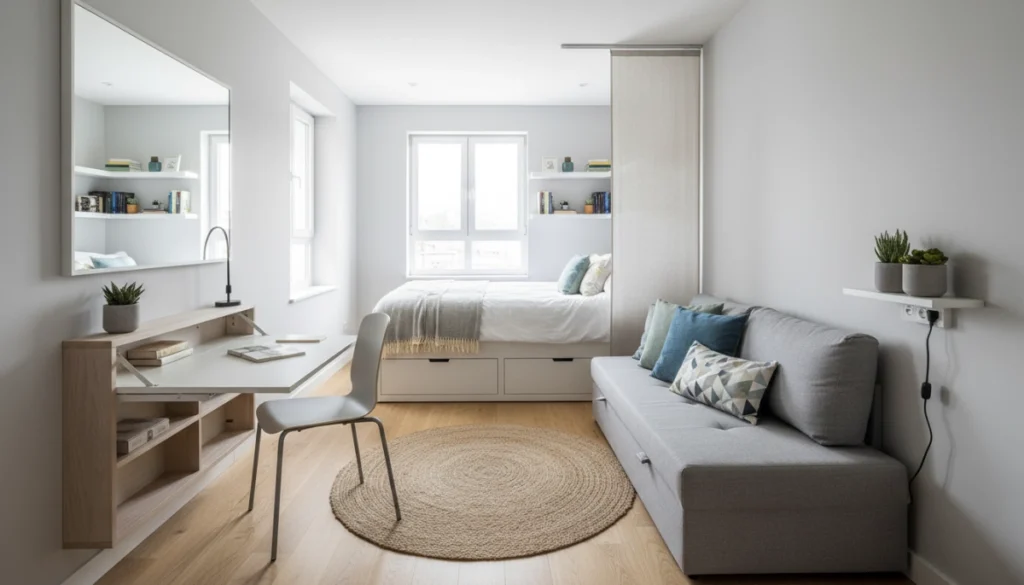
Multi-Functional Furniture for Small Apartments
If you live in a small apartment, every piece of furniture has to earn its spot. I build and source space-saving pieces for exactly this reason: you shouldn’t have to choose between comfort and square footage. Here’s how I’d set up a tiny place using multi-functional furniture for small spaces that actually works in real life.
Sofa Beds, Sleeper Sectionals, and Daybeds
I always start with the main seating:
- Sofa bed:
- Use in a studio apartment layout where your living room is also your bedroom.
- Look for storage under the seat for bedding.
- Sleeper sectional:
- Great for small living rooms that host guests often.
- Choose a chaise with storage for blankets and pillows.
- Daybed:
- Perfect for an office/guest room hybrid.
- Style it with bolsters so it looks like a sofa by day.
Key tip: Pick clean lines, light fabric, and raised legs so the piece doesn’t visually swallow the room.
Storage Ottomans, Benches, and Coffee Tables
I treat every “flat surface” as a chance for hidden storage:
- Storage ottomans
- Use as a coffee table, extra seating, and a footrest.
- Store remotes, games, throws, or kids’ toys inside.
- Storage benches
- Ideal for entryways, at the foot of the bed, or under a window.
- Hide shoes, bags, or off-season items.
- Coffee tables with hidden compartments
- Go for lift-top styles that double as a laptop desk or dining spot.
- Use the inside for tech, chargers, and paperwork.
These pieces maximize apartment space without adding visual clutter.
Extendable and Drop-Leaf Dining Tables
In a small apartment, the dining table needs to flex with your life:
- Extendable dining tables
- Everyday: keep it in compact mode for 2 people.
- Guests: pull out the leaf and seat 4–6.
- Drop-leaf tables
- Push against the wall as a console or desk.
- Open one leaf for solo meals, both leaves when entertaining.
If you’re really tight on space, I love a wall-mounted drop-leaf table that folds completely flat when not in use.
Desks That Double as Vanities or Consoles
One surface, multiple “jobs”:
- Desk + vanity
- Use a slim desk in the bedroom.
- Add a mirror that can stand or lean (no drilling), and a drawer organizer for makeup and office supplies.
- Desk + console
- In the living room, a narrow desk works as a media console by day and a workstation when you slide in a chair.
- Hide cords with cable clips and baskets.
This is a simple way to create a space-saving home office in an apartment without a dedicated room.
How to Pick Multi-Use Pieces Without Overcrowding
The biggest mistake I see in small apartment decorating ideas is buying too many “do-it-all” items and creating chaos. Here’s how I avoid that:
- One hero per zone
- Living room: choose either a sofa bed or a sleeper sectional, not both.
- Dining area: pick one extendable or drop-leaf table and keep chairs simple.
- Stick to a light, cohesive look
- Use light wood, white, beige, or soft gray to keep things airy.
- Choose slim legs and low profiles instead of bulky bases.
- Measure first, then commit
- Tape out dimensions on the floor before you buy.
- Make sure you can fully extend the bed, table, or leaf and still walk around it.
- Prioritize your real life
- Host often? Invest in a good sleeper sectional.
- Work from home? Put your money into a functional desk that can double as a vanity or console.
When you choose intentional, multi-functional furniture, your small apartment feels bigger, calmer, and more flexible—without sacrificing comfort or style.
Vertical storage solutions that maximize apartment space
When floor space is tight, I always tell people: go vertical first. The right vertical storage solutions can double how much your small apartment can hold without feeling crowded.
Floor-to-ceiling bookshelves and wall units
Tall units pull the eye up and make ceilings feel higher while packing in storage.
- Use floor-to-ceiling bookshelves to store books, decor, baskets, and even bins for random stuff.
- In small living rooms, choose slim wall units instead of deep bulky cabinets.
- Style shelves in thirds:
- 1/3 books
- 1/3 baskets/boxes (for ugly items)
- 1/3 decor (plants, frames, a few personal pieces)
Look for modular, budget units (IKEA, Target, Walmart) that you can line up for a faux “built-in” look.
Wall-mounted desks, nightstands, and consoles
Wall-mounted pieces are game-changers in small studio apartments.
- Install a wall-mounted desk that doubles as a workspace and vanity.
- Use floating nightstands so you keep floor space open for baskets or a small stool.
- In narrow entryways, go with a slim floating console for keys, mail, and a small tray.
These wall-mounted storage ideas keep the footprint small but still give you real function.
High kitchen shelving and over-cabinet storage
Most U.S. apartments waste the top 1–2 feet of wall space in the kitchen.
- Add high open shelves above existing counters for rarely used appliances, serving platters, and pantry backstock.
- Use over-cabinet storage with baskets or clear bins for paper towels, extra dry goods, and party supplies.
- Keep daily-use items at eye level; stash bulk or backup items up high.
Stick to matching containers and labels so it looks clean, not chaotic.
Using space above doors and wardrobes
Those weird gaps above doors and closets are prime real estate.
- Mount a shelf above the door in the bathroom for extra towels, toilet paper, and cleaning supplies.
- Add a long shelf above a wardrobe or closet for luggage, off-season clothes, or extra bedding.
- Use baskets so it doesn’t look messy and so you’re not staring at random stuff.
This is one of the easiest tiny apartment hacks that doesn’t eat into living space.
Safety and renter-friendly mounting tips
You can still maximize apartment space without losing your deposit.
- Use stud finders for heavy pieces (bookshelves, wall desks) and always use proper anchors for drywall.
- For rentals, try no-drill options:
- Tension rods for lightweight shelves
- Command hooks/strips for small racks and organizers
- Leaning ladder shelves instead of fully wall-mounted units
- Never overload floating shelves—follow the weight rating.
- For tall bookshelves, strap or bracket them to the wall to prevent tipping, especially if you have kids or pets.
Dialing in vertical storage lets you keep your small apartment organized, safe, and flexible without sacrificing style.
Light Color Palettes to Make Small Apartments Feel Bigger
Best light and neutral colors for tiny apartments
For small apartment decorating ideas that actually maximize apartment space, I lean hard on light, low-contrast colors. They bounce light around and visually push the walls out.
Go-to paint colors for small spaces:
- Warm whites: soft white, cream, ivory
- Light beiges & greiges: oatmeal, sand, warm gray-beige
- Soft pastels: pale blush, powder blue, sage, misty green
- Light grays: very soft, warm gray (avoid dark, cool “battleship” grays)
These shades work well in U.S. apartments with mixed natural light and standard builder lighting.
Using white, beige, and soft pastels to reflect light
To make a tiny apartment feel bigger, treat your light palette like a system:
- Walls: white, off-white, or very light beige to reflect the most light
- Large furniture: stick to light neutrals (beige, light gray, cream)
- Textiles: curtains, bedding, and big area rugs in soft neutrals or pale pastels
This combo turns even a small studio apartment layout into a brighter, more open-feeling space without renovations.
Balancing light walls with darker accents
You don’t have to give up contrast. You just have to control it.
Smart ways to bring in darker tones:
- Use dark accents in small doses: pillows, throws, frames, a single accent chair
- Keep big surfaces light: walls, sofa, rug, curtains
- Choose medium wood tones instead of super dark espresso if the space is really tight
Think 80–90% light, 10–20% darker accents. That ratio keeps the room grounded without making it feel smaller.
Accent walls that don’t shrink the room
Accent walls can work in small space decorating ideas—you just have to be picky:
- Choose a subtle accent: 1–2 shades darker than your main wall color, not a huge jump
- Accent the shortest wall or the wall behind the bed/sofa, not the longest wall
- Use texture instead of heavy color: limewash, grasscloth-look wallpaper, or tone-on-tone stripes
Skip super dark accent walls in tiny apartments unless you have great natural light and lots of light furniture to balance them.
Coordinating color across open-plan spaces
Most U.S. small apartments have some version of an open-plan living/dining/kitchen. Color can either connect it or chop it up.
To keep the whole space feeling bigger:
- Use one main wall color throughout the living room, kitchen, and hallway
- Repeat 2–3 core colors (e.g., white, sand, soft green) in furniture, rugs, and art
- Keep trim, doors, and baseboards one consistent light color
- Let rugs and textiles define zones instead of changing wall colors every few feet
This kind of simple, coordinated palette is one of the easiest tiny apartment hacks to make everything feel more intentional, airy, and calm.
Mirror tricks to visually expand small rooms
Mirrors are one of the easiest small apartment decorating ideas I rely on to instantly make a space feel bigger, brighter, and more open—especially in tight U.S. rentals where I can’t knock down walls.
Placing mirrors opposite windows
To maximize apartment space visually, I always use mirrors like “second windows”:
- Place a medium or large mirror directly opposite or diagonal to a window to bounce natural light deeper into the room.
- In a small living room, hang a horizontal mirror behind the sofa facing the window.
- In a tiny apartment kitchen, a mirror on the wall opposite the sink or dining nook makes the whole area feel less cramped.
This simple move is one of the best optical illusions for small rooms.
Full-length mirrors in narrow hallways and entryways
In tight U.S. hallways and rental entryways, I treat full-length mirrors as functional decor:
- Lean or mount a full-length mirror at the end of a narrow hallway to visually extend it.
- In a small entryway, use a full-length mirror beside a slim shoe rack or wall hooks so it acts as both a dressing mirror and a light booster.
- Go with a thin frame (black, white, or wood) to keep it clean and modern, not bulky.
Mirror gallery walls in living and dining areas
If you like a little personality, a mirror gallery wall can be a smart small apartment decor move:
- Mix different shapes (round, oval, square) but keep frames in 1–2 colors for a calm look.
- Place a gallery of smaller mirrors above a compact sofa, console, or dining table to lift the eye and reflect light.
- In an open-plan studio apartment layout, a mirror gallery helps separate the “living” wall from the “sleeping” area without blocking light.
Mirrored furniture and decor in small apartments
Used right, mirrored furniture is a powerful tiny apartment hack:
- A glass or mirrored coffee table in a small living room keeps the center of the room visually open.
- Mirrored nightstands, consoles, or side tables reflect nearby walls and rugs, making the footprint feel bigger.
- I keep the rest of the furniture matte or soft-textured so the space doesn’t feel like a nightclub.
Common mirror placement mistakes to avoid
A few mirror mistakes can actually shrink or clutter a small space:
- Facing clutter: Don’t place mirrors opposite open shelving, messy desks, or bulky TV units—you’ll just double the chaos.
- Too high: Hang mirrors at eye level (about 57″–65″ from the floor to center) so they feel intentional, not floating.
- Too many: One strong mirror per wall is usually enough in a tiny apartment. Too many reflections feel busy.
- Bad reflections: Avoid mirrors facing toilets, awkward corners, or dark blank walls—they won’t add anything.
Used thoughtfully, mirrors are one of the fastest, budget-friendly ways to maximize apartment space, especially in U.S. rentals where you need renter-friendly, no-renovation upgrades.
Furniture with exposed legs for visual space
When I’m working with small apartment decorating ideas, I almost always lean on furniture with exposed legs. Raised pieces let you see more floor, which instantly makes a tiny apartment feel lighter and less cramped.
Why raised furniture makes small rooms feel airy
Open-base, leggy pieces are an easy tiny apartment hack:
- You see more floor, so the room feels bigger.
- Light can travel under the furniture, which keeps corners from feeling heavy.
- Cleaning is easier, which matters in small space decorating ideas where every inch counts.
Choosing sofas, chairs, and beds with slim legs
When I pick space-saving furniture for a small living room or studio, I look for:
- Slim, tapered legs on sofas and chairs (mid-century styles work great).
- Bed frames with at least 6–8 inches of clearance for under-bed storage solutions.
- Armchairs and accent chairs that feel visually light, not bulky or skirted.
Stick to 1–2 main leg finishes in the room (like black metal and light wood) so the layout feels calm, not busy.
Mixing open-base pieces with a few solid items
You don’t need everything floating on legs. I usually:
- Use open-base sofas, chairs, and TV stands to keep the room airy.
- Add one or two solid pieces (like a closed credenza or storage ottoman) for hidden storage.
- Keep any solid, heavy pieces against walls so they don’t block sightlines in a small apartment layout.
Best materials and finishes for light, open looks
To maximize apartment space, materials matter as much as shape:
- Light woods (oak, maple, birch) keep things bright.
- Metal legs in black, white, or brass give a slim, modern profile.
- Linen, cotton, or performance fabric in light neutrals (white, beige, greige, soft gray) visually open up the room.
- Pair leggy furniture with a light, low-contrast rug so pieces feel like they “float.”
This combo of exposed-leg furniture, light finishes, and simple lines is one of the fastest ways to make a small apartment look larger without sacrificing comfort.
Under-bed storage hacks for small apartments
Under-bed space is prime real estate in any small apartment, and I treat it like a built-in closet I don’t have to pay extra rent for.
Using storage bins, drawers, and rolling boxes
For small apartment decorating ideas that maximize space, I always start under the bed:
- Use low-profile storage bins with lids (clear plastic or labeled fabric) so you can see what’s inside fast.
- Go for rolling boxes or drawers if you access them a lot—ideal for shoes, everyday linens, or kids’ toys.
- If your bed frame is open, pick uniform containers so it looks clean, not chaotic.
- Measure the height from floor to bed frame before buying; most under-bed bins are 6–8 inches high.
These simple pieces are some of the easiest tiny apartment hacks you can put in place in a weekend.
Bed risers and lofted beds to create extra space
If you’re tight on storage, raising the bed can literally buy you cubic feet:
- Bed risers: Cheap, renter-friendly, and perfect for adding just enough height for taller bins or rolling drawers.
- Lofted beds: In very small apartments or studios, lofting the bed gives you room for a desk, dresser, or seating area underneath.
- For adults, I keep it practical—no wobbly frames. Look for solid wood or metal and check the weight limits.
This is where space-saving furniture and small space decorating ideas really pay off.
Storing off-season clothes, linens, and gear
I use under-bed storage for anything I don’t need every day:
- Off-season clothes: Pack by category (winter coats, sweaters, summer dresses) in vacuum storage bags inside bins.
- Extra linens: Store sheet sets in their pillowcases so they stay together.
- Gear: Think holiday decor, spare blankets, guest pillows, travel bags, even camping gear if it fits.
Label everything clearly so your compact home organization doesn’t turn into a treasure hunt every time you need a sweater.
Keeping under-bed storage dust-free and organized
Dust is the downside, but it’s easy to control:
- Use lidded bins or drawers instead of open baskets.
- Add a bed skirt or fitted under-bed panel if your bed frame allows—it hides storage and blocks some dust.
- Do a quick pull-out and vacuum under there every 1–2 months.
- Keep a simple system:
- One bin: off-season clothes
- One bin: extra bedding
- One bin: misc gear / rarely used items
Dialing in your under-bed storage solutions is one of the fastest ways to maximize apartment space without adding bulky furniture or drilling into walls.
Room dividers that keep a small apartment open
When I plan small apartment decorating ideas, I always use room dividers that separate zones without killing light or airflow. The goal is privacy and function, not walls that make your place feel smaller.
Open shelving and bookcases as partitions
Open shelving is one of my favorite tiny apartment hacks.
- Use backless bookcases or open shelving units to divide a studio apartment layout
- Store books, baskets, and decor while still letting light pass through
- Keep the lower shelves lighter (baskets, small items) and the upper shelves more open to avoid a heavy look
- For renters, choose freestanding units so you don’t have to drill into walls
This gives you a “wall” plus vertical storage solutions in one move.
Curtains and ceiling tracks for flexible zones
Curtains are perfect when you want privacy on demand.
- Install ceiling tracks to create a “wall” between your bed and living area
- Use sheer curtains if you want light and air, heavier curtains if you need more privacy
- Choose light, neutral colors so the divider doesn’t dominate the room
- Slide the curtains open during the day to keep the studio apartment layout feeling open
It’s one of the easiest renter-friendly decor tips that looks clean and intentional.
Folding screens and portable partitions
Folding screens work well if you like to rearrange often or host guests.
- Go for lightweight, foldable screens you can tuck behind a sofa or in a closet
- Choose woven, perforated, or shoji-style panels that let a bit of light through
- Use them to shield your bed, desk, or entry area when needed
- Move them around to switch between work mode, relax mode, and guest mode
They’re a simple form of space-saving furniture that doesn’t commit you to one layout.
Creating “rooms” in studio apartment layouts
To make a studio feel like a one-bedroom without building walls:
- Pair a room divider (open shelf, curtain, or screen) with a rug to define each zone
- Align your sofa back toward the “bedroom” to act as a soft boundary
- Keep bedside lighting low and cozy, and living room lighting brighter, so each “room” feels different
- Keep circulation clear: you should be able to walk through in a straight, simple path
This is how I break one room into sleep, work, and lounge zones while keeping everything visually connected.
Avoiding dividers that make spaces feel cramped
Some dividers work against you and shrink your space. I avoid:
- Solid, dark bookcases placed perpendicular in the middle of the room
- Tall, heavy wardrobes used as central dividers
- Multiple different divider types in one tiny apartment (it looks chaotic)
- Dividers that block windows, radiators, or main walkways
When in doubt, choose light colors, open designs, and movable pieces. That’s how you maximize apartment space while keeping your small apartment decor clean, flexible, and easy to live in.
Floating shelves and wall hooks for tiny apartments
Floating shelves and wall hooks are some of the easiest small apartment decorating ideas that actually maximize apartment space without eating up your floor. I use them anywhere I can in a small space because they double as storage and decor.
Slim floating shelves in living rooms and bedrooms
For tiny apartments, keep floating shelves slim and light:
- Living room ideas
- Narrow shelves above the sofa for framed art, a small plant, and a candle
- A thin shelf under the TV for remotes and small decor (instead of a bulky console)
- Bedroom layout tips
- Use floating shelves as nightstands on both sides of the bed
- Add a long, shallow shelf above the headboard for books and a small reading light
Stick to white, wood, or wall-color shelves so they blend in and don’t visually crowd the room.
Wall hooks and pegboards in entryways and kitchens
Hooks and pegboards are tiny apartment hacks that keep stuff off the floor and counters:
- Entryway organization in small spaces
- Row of hooks for coats, bags, dog leashes, and umbrellas
- Small shelf + hooks combo for keys, wallet, and mail
- Pegboards in kitchens
- Hang pans, colanders, and utensils
- Add mini shelves for spices and oils
Pegboards are perfect for renters because you can cover a lot of wall with just a few anchor points.
Hanging rails and magnetic strips for utensils and tools
To maximize a tiny kitchen or workspace, get things vertical:
- Kitchen rails
- Mount a rail with S-hooks for spatulas, mugs, cutting boards, and towels
- Add a rail under cabinets to hang small baskets for spices
- Magnetic strips
- Magnetic knife strip instead of a chunky knife block
- Use in a home office for small metal tools, scissors, clips
These space-saving ideas free up drawers and counter space fast.
Styling shelves without visual clutter
Floating shelves can look messy fast in a small apartment. I keep them tight and edited:
- Follow a “1 function + 1 decor” rule per shelf (example: stack of books + one plant)
- Group items in odd numbers (3 or 5) for a cleaner look
- Use neutral decor with one accent color so your shelves don’t feel busy
- Hide small loose items in small boxes or baskets
If it looks crowded from across the room, remove 1–2 items. Less is more in tiny spaces.
Renter-friendly hanging and removal tips
If you’re renting in the U.S., you can still use wall-mounted storage ideas without losing your deposit:
- Use removable adhesive hooks and strips for lighter shelves and rails (check weight limits)
- For heavier floating shelves, use anchors in studs, then:
- Keep all screws
- Spackle, sand, and touch up paint when you move out
- Try over-the-door hooks and organizers where you can’t drill
- Test adhesives on a small spot first so you don’t peel paint
Done right, floating shelves and wall hooks give you compact home organization, smart apartment decorating, and more storage without adding bulky furniture.
Foldable and Nesting Furniture Ideas That Maximize Apartment Space
Foldable and nesting furniture is one of the fastest ways to maximize apartment space without giving up comfort. In a small U.S. apartment, these pieces let you flex between “everyday mode” and “hosting mode” in minutes.
Nesting Coffee Tables and Side Tables
Nesting tables are a classic small apartment decorating idea because they expand only when you need them.
Look for:
- 2–3 piece nesting coffee tables for small living rooms
- Slim nesting side tables that slide under sofas or beds
- Glass or acrylic nesting tables to keep a tiny apartment feeling light and open
Use the smallest table daily, then pull out the rest for snacks, laptops, or game night.
Fold-Out and Wall-Mounted Drop-Leaf Desks
If you work from home in a studio apartment layout, a drop-leaf desk saves serious floor space:
- Wall-mounted drop-leaf desks that fold flat after work
- Console tables that flip open into a laptop or writing desk
- Fold-out desks with hidden storage for chargers, notebooks, and pens
Mount a simple shelf above as extra vertical storage and keep the floor clear.
Stackable and Folding Chairs for Guests
Instead of cramming in bulky dining chairs, go with space-saving furniture that hides away:
- Stackable chairs that can live in a closet or corner
- Folding chairs that hang on wall hooks or sit behind a door
- Slim, padded styles that still feel comfortable for a full dinner
Keep 2–4 extra chairs on hand so hosting doesn’t feel cramped.
Collapsible Kitchen Carts and Islands
In a tiny kitchen, mobile pieces do the heavy lifting:
- Collapsible kitchen carts with drop leaves for extra prep space
- Rolling kitchen islands that park against a wall when not in use
- Carts with drawers and hooks for utensils, spices, and small appliances
These are perfect tiny apartment hacks for renters who can’t renovate but need more counter space.
Where to Store Foldable Pieces
The trick is planning a “home” for every foldable item so your compact home organization doesn’t fall apart:
- Behind doors: hang folding chairs on strong wall hooks
- Under the bed: slide folding desks, slim tables, or extra leaves
- Closets: dedicate one narrow section for stacked folding chairs
- Between furniture and walls: tuck folding tables behind the sofa or fridge
- Balcony or entryway: store outdoor-use folding chairs in a slim rack
When you treat foldable and nesting furniture like part of your small space decorating system, your apartment stays flexible, tidy, and ready for whatever you’re doing that day.
Layered lighting to open up small spaces
Layered lighting is one of the fastest ways to make a small apartment feel bigger, warmer, and more expensive—without a full renovation. I always treat lighting in tiny apartments like a 3-part system: ambient, task, and accent. When all three are working together, your space feels open instead of cramped.
Combine ambient, task, and accent lighting
Use at least 3–5 light sources in a small apartment, not just one overhead.
- Ambient lighting (overall glow)
- Flush-mount or semi-flush ceiling lights
- Large floor lamps that bounce light off the ceiling
- Smart bulbs so you can dim and change color temperature
- Task lighting (focused where you work)
- Desk lamps for work-from-home setups
- Under-cabinet lights in tiny kitchens
- Bedside lamps or sconces for reading
- Accent lighting (mood + depth)
- LED strip lights behind TVs or shelves
- Small table lamps on consoles
- Picture lights or spotlights for art
Tip: In a small living room or studio apartment layout, spread your lights around the perimeter of the room. That pulls the eye outward and helps maximize apartment space.
Wall sconces and plug-in lights for renters
If you rent and can’t hardwire, plug-in lighting is your best friend.
- Plug-in wall sconces beside the bed or sofa free up nightstand and side table space
- Plug-in swing-arm lamps work as reading lights or task lights without needing a big floor lamp
- Use Command hooks, cable clips, and cord covers to route cords neatly
- Look for adjustable heads so one sconce can do double duty as ambient and task lighting
You get the “built-in” look of wall lighting with zero drilling or electrician bills—perfect for small apartment decorating ideas on a budget.
Floor lamps that save space and add height
Floor lamps are a simple way to open up a small room and add vertical interest.
- Choose tall, slim floor lamps that tuck behind a sofa, chair, or in a corner
- Arc floor lamps can replace overhead lighting in rentals
- Tripod or column lamps draw the eye up, making ceilings feel higher
- Avoid bulky drum bases that eat up precious floor space
In a small living room, I like one tall floor lamp in a corner plus a table lamp on a side table. It feels cozy but not crowded.
Under-cabinet and LED strip lighting tricks
LED strips are one of the best tiny apartment hacks—they’re cheap, low-profile, and renter-friendly.
- Under-cabinet strips in the kitchen:
- Brighten dark counters
- Make a tiny kitchen feel bigger and more functional
- LED strips behind:
- TVs (instant “media wall” vibe)
- Floating shelves
- Headboards or bed frames
- Use motion-sensor puck lights inside closets or pantries with no wiring
- Go for warm white (2700K–3000K) strips to avoid a harsh, blue look
Most LED strips have adhesive backs, so they’re easy to remove when you move out—perfect renter-friendly decor.
Warm vs cool light in small rooms
Color temperature matters more than people think in small spaces.
- Warm white (2700K–3000K)
- Best for living rooms, bedrooms, and cozy zones
- Softer, more relaxing, hides imperfections on walls
- Neutral to cool white (3500K–4000K)
- Good for kitchens, bathrooms, and work areas
- Makes tasks easier but can feel clinical if overused in tiny apartments
For most small apartments in the U.S., I aim for:
- Warm light in living/sleeping areas
- Neutral in the kitchen/desk zone
- Use dimmable bulbs so you can switch from “focus mode” to “movie night” without swapping fixtures
Dialing in layered lighting like this doesn’t just brighten your small space—it makes every square foot work harder.
Decluttering and Smart Organization Systems
Set Simple Decluttering Rules for Small Apartments
In a small apartment, clutter kills space. I follow a few non‑negotiable rules:
- One in, one out: If I bring in a new decor piece, hoodie, or mug, one has to leave.
- Cap categories: Decide limits (ex: 10 glasses, 3 sets of bedding, 2 coats per season).
- 15-minute reset: Every night, spend 10–15 minutes putting things back where they belong.
These tiny apartment hacks keep my space light and livable without feeling like I’m always cleaning.
Drawer Organizers, Dividers, and Trays
To maximize apartment space, every drawer needs a job. I use:
- Utensil trays in the kitchen for forks, knives, gadgets.
- Shallow dividers in bathroom drawers for skincare, makeup, medicine.
- Small trays in nightstands for chargers, remotes, glasses.
These smart compact home organization tools stop drawers from becoming black holes.
Over-the-Door Organizers That Actually Help
Over-the-door storage is prime real estate in a small apartment:
- Shoes & accessories: Use fabric or clear organizers on bedroom/closet doors.
- Pantry & cleaning supplies: Hang sturdy over-the-door racks on a hall closet or pantry door.
- Entryway overflow: Hooks or pocket organizers for hats, dog leashes, umbrellas.
You get bonus storage without drilling, perfect for renter-friendly decor.
Clear Bins, Labels, and Baskets
If I can’t see it, I forget it. In tight spaces, I use:
- Clear bins for pantry, under-bed storage, and closets.
- Simple labels (tape + marker works) so everyone knows what goes where.
- Neutral baskets for things I don’t want to see—cables, remotes, random tech.
This mix keeps things minimalist but still super functional.
Daily Habits That Keep Small Spaces Tidy
A small apartment gets messy fast, so habits matter more than storage:
- Never leave a room empty-handed: Always grab something that needs to go back.
- Laundry flow: Hamper → wash → fold → put away the same day.
- Clear surfaces nightly: Kitchen counters, coffee table, and entryway stay mostly empty.
These small space decorating ideas only work when clutter is under control. Smart systems plus simple routines are what truly maximize apartment space.
Budget “built‑in” looks without renovations
Modular cubes to fake built‑in bookcases
If you want that custom, high-end look without hiring a contractor, modular cubes are your best friend. I use them constantly in small apartment decorating ideas because they’re cheap, flexible, and renter-friendly.
- Line cube units along a wall, then stack them to the ceiling to fake a built‑in bookcase.
- Stick to one color (white, black, or wood tone) so it feels like one solid piece, not a bunch of parts.
- Add doors or baskets on the lower cubes for hidden storage and keep open cubes up top for books and decor.
- Use simple, matching hardware so it leans more “custom cabinet” and less “dorm shelf.”
This is a quick way to maximize apartment space and get serious storage without touching the walls.
Custom‑feel wardrobes along one wall
For tiny bedrooms and studio apartments, I like to turn one full wall into a “closet wall” using ready-made wardrobes.
- Line up two or three tall wardrobes (IKEA Pax-style, Wayfair, etc.) tight together.
- Choose flat-front doors in a neutral color for a sleek, minimalist apartment design.
- Add interior organizers (drawers, shelves, hanging rods) to handle clothes, shoes, and extra linens.
- If you can, secure them with renter‑friendly brackets and command strips so they don’t tip but still come down clean.
You end up with a custom closet wall that looks built-in, adds massive storage, and works in any small bedroom layout.
Affordable media wall units
Instead of a big bulky entertainment center, I like to build a “media wall” using budget units.
- Start with a low TV stand in the middle.
- Flank it with two bookcases or cabinets on each side for a simple media wall.
- Add floating shelves above the TV (no-drill options if needed) to extend the look up.
- Keep cords controlled with cable covers in the same color as your wall.
It reads as a custom media built‑in, but it’s just smart, modular, space-saving furniture.
Color‑matching for a seamless look
One of the easiest tiny apartment hacks: make furniture “disappear” by matching it to your walls.
- Paint or choose furniture in the same color as your walls (or a shade close to it).
- For white or beige walls, go for white, cream, or light wood units so everything blends.
- Avoid big color jumps; low contrast = less visual clutter and a room that feels bigger.
This trick is powerful in small living room ideas and small studio apartment decor, where visual calm matters.
When to invest vs DIY in a rental
In a rental, I treat every dollar as an investment I can take with me. Here’s how I decide:
DIY or budget pieces when:
- You’re using modular cubes, bookcases, and wardrobes that can move with you.
- You want simple, renter-friendly decor that doesn’t require drilling or custom cuts.
- You’re testing a layout and may reconfigure furniture later.
Invest a bit more when:
- You’re buying quality wardrobes or a media unit you’ll use long-term in any apartment.
- You need sturdy, multi-functional furniture (like big wardrobes or tall cabinets) for real storage.
- The piece solves a key problem: tiny kitchen organization, no closet, or zero built-in storage.
The goal: get that built‑in look on a budget, without losing flexibility or risking your security deposit.
Space-Saving Greenery and Plant Ideas That Maximize Apartment Space
Bringing in plants is one of the easiest small apartment decorating ideas, but you have to do it in a way that doesn’t eat up floor space or make the room feel crowded. Here’s how I handle greenery in tight apartments.
Hanging Planters and Ceiling Hooks
Hanging planters are a go‑to tiny apartment hack when floor space is limited.
- Use ceiling hooks near windows, over kitchen sinks, or in corners you never walk through.
- Keep cords and chains simple (black, white, or brass) so the plants feel light, not busy.
- In rentals, use tension rods in window frames or no-drill adhesive ceiling hooks rated for the plant’s weight.
- Best plants for hanging: pothos, philodendron, string of pearls, spider plants.
Wall Planters, Rails, and Plant Shelves
Wall-mounted storage ideas work for plants too and help maximize apartment space vertically.
- Install slim wall planters or rail systems (like a mini kitchen rail) for herbs and small trailing plants.
- Use narrow floating plant shelves above a sofa, desk, or toilet—keep them shallow so they don’t feel bulky.
- Stick to one clean grid or row instead of lots of random pieces to avoid visual clutter.
Slim Floor Planters for Corners and Windows
If you want floor plants in a small living room, go tall and slim.
- Choose narrow, tall planters that tuck into corners or sit beside a sofa or TV stand.
- Use plant stands to stack two or three plants vertically instead of spreading them out.
- Place one slim planter on each side of a window or balcony door to frame the view without blocking it.
Low-Maintenance Plants for Low-Light Apartments
Most U.S. apartments don’t get perfect light, so pick plants that can handle it.
- Great low-light options: ZZ plant, snake plant, pothos, philodendron, peace lily.
- For very dark corners, go faux or use grow bulbs in existing lamps.
- Group plants with similar light and watering needs together to keep care simple.
Keeping Plants From Overwhelming Small Rooms
Plants should make a small apartment feel fresh, not cluttered.
- Set a hard limit (for example, 5–7 plants in a studio, 8–10 in a one-bedroom).
- Keep pots in one color palette (white, black, terracotta, or neutral stone) so the greenery stands out, not the containers.
- Use one “plant zone” per area: a hanging cluster in the living room, a rail of herbs in the kitchen, a single floor plant in the bedroom.
- Edit regularly—if a plant is struggling or too big, rehome or move it instead of forcing it to fit.
Used right, space-saving greenery becomes one of the most effective small space decorating ideas: it softens hard edges, adds color, and still keeps your tiny apartment feeling open and calm.
Curtain tricks to make ceilings look higher
When I’m trying to maximize apartment space without doing any construction, curtains are one of my favorite small apartment decorating ideas. A few simple tweaks can make ceilings look higher and rooms feel bigger.
Hang curtains close to the ceiling
Skip mounting your rod right above the window trim.
- Mount the rod 2–4 inches below the ceiling (or at the top of the wall if you have crown molding).
- Use 84″–96″ or longer panels so they just “kiss” the floor.
- Go for ceiling-mounted tracks in super small studio apartment layouts where wall space is tight.
This vertical line pulls the eye up and makes the room feel taller instantly.
Extend curtain rods wider than the window
Narrow rods make windows look small and walls feel cramped.
- Extend the rod 4–8 inches past each side of the window.
- When curtains are open, they sit outside the glass, so you keep more natural light.
- This trick is huge for tiny apartments and small living rooms that need every inch of light.
Sheer vs blackout curtains in small apartments
Light control matters, but so does visual space.
- Sheer curtains
- Best for small studios and dark apartments
- Let in light, soften views, and keep the room feeling open
- Layer with blinds or roller shades for privacy
- Blackout curtains
- Use mainly in bedrooms or night-shift setups
- Choose light colors and hang them high and wide to avoid a heavy, closed-in look
- Consider blackout liners behind sheers for a flexible setup
I usually use sheers in living areas and blackout-lined panels only where sleep is the priority.
Use one curtain style across multiple windows
In a small open-plan apartment, visual consistency keeps things calm instead of cluttered.
- Stick to one fabric and color family for living room + dining + home office areas.
- Even if rod styles vary (tension rods, no-drill brackets), keep the curtain panels matching.
- This creates a clean, unified look that makes a small space feel larger.
Patterns and colors that don’t shrink the room
The wrong fabric can make a tiny apartment feel even smaller.
- Best bets:
- Solid light colors: white, ivory, beige, warm gray
- Soft vertical stripes (subtle, not high contrast)
- Small, low-contrast patterns if you want interest
- Avoid:
- Heavy, dark fabrics across multiple windows
- Loud, high-contrast prints in a small living room or small bedroom
- Short “café” curtains that chop the wall visually
For most U.S. apartments, I recommend light, full-length curtains hung high and wide. It’s one of the simplest tiny apartment hacks to make ceilings look higher, rooms feel bigger, and your small space decorating ideas actually work in real life.
Slim-profile furniture for narrow rooms
When I’m working with a narrow room in a small apartment, slim-profile furniture is non‑negotiable. It lets you walk through the space without that “squeezing by the sofa” feeling and still gives you real comfort.
Choosing narrow sofas, armless chairs, and benches
For small apartment decorating ideas that actually work day to day, I look for:
-
Narrow sofas (28″–34″ deep)
- Clean arms or track arms instead of big rolled arms
- Straight backs, no bulky cushions sticking out
- Tight-back sofas (no loose back pillows) to save a couple inches
-
Armless chairs and benches
- Armless accent chairs slide closer to walls and into corners
- Benches instead of bulky chairs around a table or under a window
- Storage benches by the entry for shoes and bags in tight hallways
These slim pieces maximize apartment space without making the room feel cramped.
Shallow-depth consoles for hallways and entryways
In narrow hallways and entryways, depth kills flow. I keep consoles:
- 10″–14″ deep for tight walkways
- Open-frame bases or floating consoles for a lighter look
- Drawers or baskets underneath for compact home organization
This hits that sweet spot: storage + landing zone + no hip-bumping.
Round vs rectangular tables in tight spaces
Both work in a tiny apartment layout, but I pick based on traffic flow:
-
Round tables
- Best for tight corners and small dining nooks
- Easier to move around, no sharp corners
- Great in small studio apartment decor where space is shared
-
Rectangular or oval tables
- Better along a wall or in very narrow rooms
- Narrow depth (24″–30″) still seats 2–4 people
- Works as a dining table + desk in a compact living room
If you constantly walk around the table, go round. If you push it against a wall, go slim rectangular.
Balancing slim furniture with comfort and support
Slim-profile furniture should still feel good to use. I keep it simple:
- Look for firm, supportive cushions (soft sinks eat up space and feel sloppy)
- Make sure seat height is standard (around 17″–19″) so guests and family are comfortable
- Pair narrow sofas with plush pillows and throws for cozy, not bulky, comfort
- Mix a few slim pieces with one slightly more substantial item so the room doesn’t feel cheap or flimsy
Used right, slim-profile furniture is one of the most effective small space decorating ideas for U.S. apartments: you get clear walkways, enough seating, and a layout that actually works for real life.
Rugs That Define Zones in Small Apartments
Picking the right rug size for studios and 1‑bedrooms
In a small apartment, rugs act like floor plans. I always size up instead of going too small:
- Living area: front legs of the sofa and chairs on the rug (usually 5’x7′ or 6’x9′ in small living rooms).
- Dining area: rug should extend at least 24″ beyond all sides of the table so chairs stay on the rug when pulled out.
- Bed area: either a large rug that goes under 2/3 of the bed or two runners on both sides if space is tight.
This keeps each zone feeling intentional without breaking up the room too much.
Light and low-contrast rugs to unify a room
To maximize apartment space, I lean hard on light, low-contrast rugs:
- Stick with off-white, beige, gray, or soft pastels that blend with your flooring.
- Subtle patterns (thin stripes, tone-on-tone geometrics) hide dirt without visually chopping up the floor.
- In a studio, using one large light rug under the main seating area makes the whole space feel larger and calmer.
Layering rugs to separate zones
Layering is one of my favorite small apartment decorating ideas because it’s flexible and renter-friendly:
- Use one large neutral rug as a base.
- Add smaller accent rugs for the “living,” “dining,” and “sleeping” zones in a studio apartment layout.
- Go flatweave for the base and a cozier pile or textured rug on top where you sit or lounge.
If you move, you can reuse all the pieces in a different layout.
Rug shapes that work in awkward layouts
Weird layout? The rug shape can fix a lot of it:
- Round rugs soften sharp corners and work great under small dining tables or in reading nooks.
- Runners are perfect for narrow living rooms, entryways, and alongside the bed.
- Oval or irregular rugs help transition between two zones without a harsh line.
When in doubt, follow the shape of the furniture grouping, not the room itself.
Renter-friendly rug pads and protection
If you rent, you need protection and grip without damage:
- Use felt + rubber rug pads to protect floors, add cushion, and keep rugs from sliding.
- In high-traffic zones (entry, kitchen), pick low-pile washable rugs so cleaning is easy.
- For kids or pets, I like stain-resistant, indoor/outdoor rugs—they’re tougher and still look good.
Smart rug choices are an easy, budget-friendly way to define zones, maximize apartment space, and make a tiny layout feel intentional without any permanent changes.
Using Corners in a Small Apartment Layout
In a small apartment, every corner is real estate. I use corners to maximize apartment space without crowding the main walkways.
Corner desks and compact workstations
Turn an unused corner into a space-saving home office:
- Pick an L-shaped corner desk or a small triangular desk that hugs the wall.
- Use a slim office chair or even a backless stool that tucks under.
- Add a wall-mounted shelf above for laptops, books, and office supplies.
This keeps your small living room or bedroom clear while still giving you a legit workspace.
L-shaped shelves and corner bookcases
Corners are perfect for vertical storage solutions:
- Install L-shaped floating shelves to hold books, decor, and plants.
- Use a tall corner bookcase to take storage all the way up.
- Keep heavy items lower and lighter decor higher so it doesn’t feel top-heavy.
You get more storage without eating into floor space in a tiny apartment.
Cozy reading nooks with chairs and lamps
If you don’t need an office, turn a corner into a cozy reading nook:
- Add a small accent chair or armless lounge chair.
- Use a slim floor lamp or wall-mounted reading light.
- Toss in a small side table for coffee and a basket for blankets.
It’s an easy way to add personality to small studio apartment decor.
Corner storage in kitchens and bathrooms
Corners in kitchens and bathrooms do a lot of heavy lifting:
- Use corner shelves for spices, mugs, or small appliances.
- Add a corner cart or triangular shelf in tight kitchen spots.
- In the bathroom, try corner shower caddies, corner cabinets, or tiered shelves.
These clever storage ideas keep counters clear in tiny kitchens and small baths.
Lighting dark corners to open up the room
Dark corners make a small apartment feel cramped. I always light them up:
- Use plug-in wall sconces or clamp lights where you can’t hardwire.
- Add tall floor lamps to draw the eye up and make ceilings feel higher.
- Place a mirror behind or near the light to bounce light across the room.
Bright corners make your whole layout feel bigger and more open—one of the simplest small space decorating ideas that actually works.
Transparent and Glass Furniture for Airy Vibes
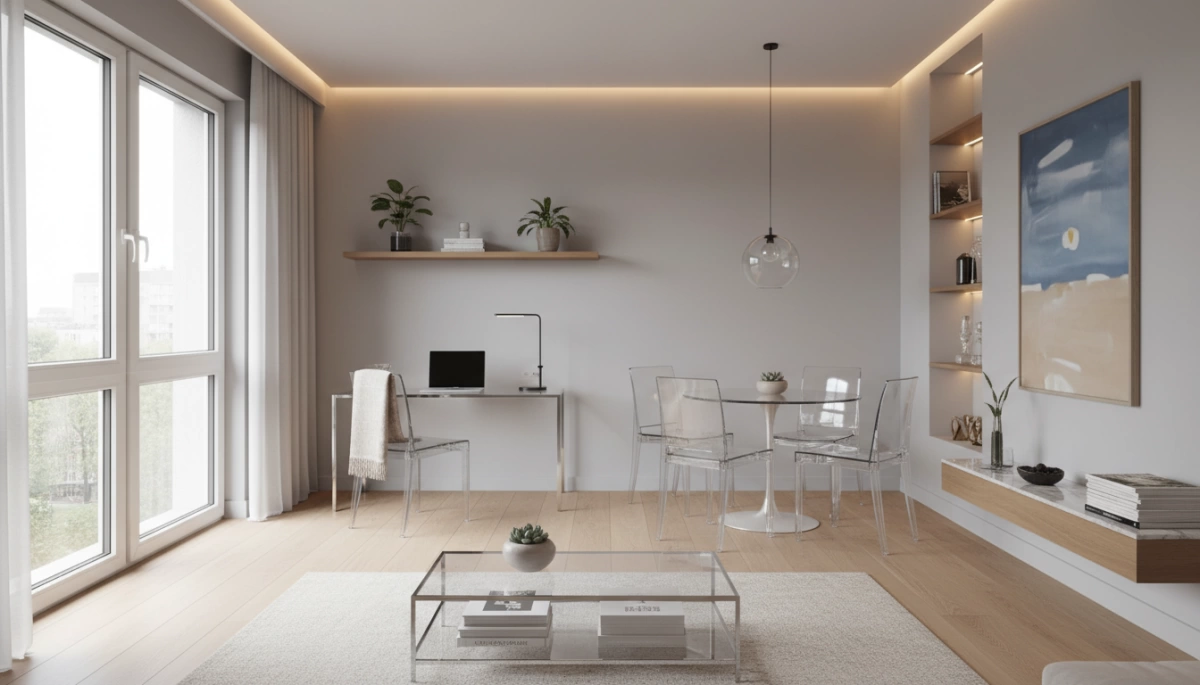
Transparent furniture is one of my favorite small apartment decorating ideas because it gives you function without visually crowding the room. In a tight space, clear pieces feel almost invisible, so your eye reads more open floor area and less “stuff.”
Acrylic and Lucite Chairs in Small Dining Areas
In a small dining nook or studio:
- Use acrylic or lucite dining chairs to keep sightlines open around a small table.
- Pair them with a round or small rectangular table to maximize apartment space and circulation.
- For comfort, add thin seat cushions in a light neutral so the chairs still look airy.
These work especially well in modern, minimalist apartment designs and small studio apartment decor.
Glass Coffee Tables and Nesting Tables
For tiny living rooms:
- Choose a glass coffee table with slim metal or wood legs so it visually “disappears.”
- Consider glass nesting tables as flexible space-saving furniture:
- Pull them out when you’re hosting.
- Tuck them together when you need floor space.
- Look for rounded corners if you’re in a narrow walkway or have kids or pets.
This is a simple tiny apartment hack that makes a small living room feel bigger.
Clear Bar Carts and Console Tables
If you like to entertain or need extra storage:
- Use a clear acrylic bar cart as a mini bar, coffee station, or rolling side table.
- A transparent console table behind the sofa or by the entry adds surface space without adding visual bulk.
- Style with just a few items: a tray, a plant, and one stack of books to avoid clutter.
These pieces double as decor and smart compact home organization.
When Transparent Pieces Work—and When They Don’t
Transparent furniture isn’t always the answer. Here’s how I decide:
They work best when:
- The apartment is small, modern, or light-filled.
- You already have a lot of solid, heavy pieces and need to visually lighten things up.
- You want to show off a rug or beautiful flooring.
They don’t work as well when:
- You have very dark, busy floors and no rug—clear pieces can just look lost.
- You already own a lot of delicate, light furniture and need visual weight to ground the room.
- You’re not great with clutter—transparent surfaces highlight every cord, magazine, and dust bunny.
As a rule, I mix one or two transparent pieces with solid storage items. That balance gives you airy vibes, keeps your small space decorating ideas practical, and still delivers that open, modern look U.S. apartments need when every square foot counts.
Modular layouts and flexible furniture arrangements
When I’m planning small apartment decorating ideas, modular layouts are my go-to for maximizing apartment space without locking you into one setup.
Reconfigurable sofas and sectionals
A modular or sectional sofa is basically grown-up Lego for your living room:
- Choose separate pieces (corner, armless, ottoman) you can move around.
- Switch layouts: L-shape for TV nights, U-shape for guests, straight sofa for a narrow room.
- Look for storage modules to hide blankets, pillows, and board games.
- Keep arms and backs low so the sofa doesn’t visually overwhelm a tiny apartment.
These multi-functional furniture pieces work especially well in studio apartment layouts where one sofa has to handle lounging, hosting, and sometimes sleeping.
Furniture on casters for easy rearranging
Wheels are a tiny apartment hack I rely on all the time:
- Coffee tables, bar carts, and small cabinets on casters move out of the way fast.
- Rolling kitchen islands double as prep space, dining, and a bar when friends come over.
- Locking wheels keep things from sliding around once you set your layout.
This kind of space-saving furniture lets you flip the room in minutes without heavy lifting.
Layout ideas for hosting guests in tiny apartments
In small living rooms and studio apartments, I design the layout so it can “flex” for company:
- Normal day mode: sofa + nesting coffee tables + one accent chair.
- Guest mode:
- Slide nesting tables to the side.
- Pull out stackable or folding chairs from a closet.
- Shift the modular sofa into a more open U or L shape for conversation.
- Overnight guests: use a sofa bed or chaise with a pull-out and keep bedding in a storage ottoman.
Think of every piece as part of a small space entertaining kit.
Create different “modes” for work, relax, and sleep
In a tiny apartment, one room has to do it all. I set up flexible zones instead of fixed rooms:
- Work mode
- Use a fold-out or wall-mounted desk behind the sofa or by a window.
- Keep a rolling file cart or small drawer unit you can tuck away after hours.
- Relax mode
- Turn the desk into a console table with a lamp and decor once the laptop is put away.
- Reposition the sectional for the best TV or window view.
- Sleep mode (for studios)
- Use a room divider, open shelf, or curtain to separate bed from sofa.
- Keep pathways clear so you’re not climbing over furniture at night.
This modular approach keeps a small apartment layout feeling intentional instead of cramped, and it lets you maximize apartment space without adding more stuff.
Intentional Decor That Avoids Clutter in a Small Apartment
When I decorate small apartments, my rule is simple: every piece has a job—function, style, or both. That’s how you keep things intentional, not cluttered.
Choose a Simple Color + Style Theme
In small spaces, too many colors and styles feel chaotic fast.
- Pick 1 main neutral (white, beige, light gray) + 1–2 accent colors (olive, navy, rust, black).
- Stick to one main style lane: modern, Scandinavian, minimalist, or cozy boho—don’t mix five looks at once.
- Repeat the same colors in pillows, art, rugs, and throws so the whole apartment feels pulled together.
- In open-plan studio apartment layouts, keep the palette consistent from living room to bedroom to visually maximize apartment space.
Edit Accessories So Only the Good Stuff Stays
Small apartment decorating ideas work best when you edit hard.
- Limit surfaces to 3–5 items max: 1 light source + 1 plant or decor object + 1 stack of books/tray.
- Prioritize art, textiles, and decor that actually matter:
- Framed photos you love
- Travel prints or local art
- One or two standout vases or sculptures
- Avoid tiny knickknacks everywhere; they read as visual clutter, not style.
Use Pillows, Throws, and Art for Personality
You don’t need a lot of stuff to make a tiny apartment feel personal.
- Add 2–4 pillows with color or texture that tie into your main palette.
- Layer one throw blanket on the sofa or bed for warmth and color.
- Use 1 large statement art piece (or a tight, cohesive gallery wall) instead of lots of small random frames.
- In small living room ideas, go big and simple with art rather than busy, tiny pieces.
Display Collections Without Overcrowding
You can show off what you love and still maximize apartment space.
- Pick one dedicated zone: a single shelf, a console, or a bookcase.
- Group items into small clusters (3–5 pieces) instead of spreading them everywhere.
- Rotate your collection:
- Keep favorites out
- Store extras in clear labeled bins under the bed or in a closet.
- Use trays on coffee tables and dressers so collections look intentional, not scattered.
Swap Decor Seasonally Without Storage Stress
US apartments rarely come with extra storage, so seasonal decor needs to stay lean.
- Keep a small “decor box” with seasonal pillow covers, 1–2 small objects, and maybe a candle or two—nothing more.
- Use pillow covers instead of full pillows to save space.
- Swap art prints in existing frames instead of adding more frames to your walls.
- Follow a one-in-one-out rule: when new decor comes in, something else goes into donation or resale.
Intentional, minimalist apartment design doesn’t mean boring—it means clarity. Fewer, better pieces, a tight color story, and edited decor will make your small space look styled, not stuffed.
Renter-Friendly Small Apartment FAQs
Best furniture types for very small apartments
For very small apartments, I stick to multi-functional furniture for small spaces:
- Sofa bed or daybed instead of a regular sofa
- Drop-leaf or extendable table for dining + desk
- Storage ottomans and benches for seating + hidden storage
- Nesting tables instead of a big coffee table
- Slim-profile furniture with exposed legs to keep things feeling open
If a piece doesn’t do at least two jobs, it usually doesn’t make the cut in a tiny apartment.
How to decorate without drilling into walls
Renter-friendly decor is all about no-drill wall decor:
- Command strips and hooks for art, mirrors, and lightweight shelves
- Leaning mirrors and art against the wall instead of hanging
- Over-the-door organizers for shoes, bags, and pantry items
- Tension rods for curtains, room dividers, and under-sink storage
- Peel-and-stick wallpaper and decals to add color and pattern
All of these come off clean, which landlords in the U.S. really care about.
Ways to make a studio feel like a one-bedroom
To make a studio apartment layout feel like a one-bedroom:
- Use open shelving or bookcases as room dividers
- Add ceiling-mounted or tension-rod curtains to zone off the bed
- Use rugs to define zones for sleep, work, and living
- Place the sofa with its back to the bed area to create a visual wall
- Keep a consistent color palette so it still feels open, not chopped up
You don’t need full walls—just smart room dividers for studio apartments.
How to maximize storage in a tiny kitchen
For tiny kitchen organization, I focus on vertical and hidden storage:
- Wall-mounted rails and magnetic strips for utensils and knives
- Over-the-door racks for pantry, spices, and cleaning supplies
- Shelf risers and organizers inside cabinets to double space
- Rolling kitchen carts or slim islands for extra prep + storage
- Clear bins and labels so nothing gets lost in the back
These clever storage ideas make even a small New York–size kitchen workable.
Budget tips for small apartment makeovers
For a budget small apartment decor refresh that still looks high-end:
- Paint or use peel-and-stick wallpaper on one accent wall
- Swap out lighting, pillows, and rugs—big impact, low cost
- Use IKEA-style modular cubes to fake built-in storage
- Buy secondhand or Facebook Marketplace for larger furniture
- Stick to a minimalist apartment design so you buy less but better
Focus your budget on one or two hero pieces (sofa, mattress, or rug) and keep everything else simple and flexible.