
Why Kitchen Organization Matters for Functionality
If your kitchen constantly feels crowded, chaotic, or stressful, it’s not you—it’s the setup. Smart kitchen organization is the fastest way to turn any space (even a tiny rental) into a functional kitchen that actually works for your real life.
Real Benefits of a Functional Kitchen
A well-organized, smart kitchen saves you time, energy, and sanity every single day:
| Benefit | What It Looks Like in Real Life |
|---|---|
| Faster meal prep | You grab what you need in seconds—no digging, no hunting. |
| Less daily stress | Clear counters, clear zones, less visual and mental clutter. |
| Easier, quicker cleanup | Everything has a home; dishes and tools go back fast. |
| More enjoyable cooking | You focus on recipes, not on finding the pan or missing spice. |
| Better use of small space | Every inch works harder with smart kitchen storage solutions. |
Common Problems in Disorganized Kitchens
When kitchen storage is random or overcrowded, you feel it immediately:
- You keep buying duplicate spices and pantry items because you can’t see what you own.
- Counters stay cluttered with mail, appliances, and “homeless” items.
- Pots, pans, and lids are stacked in loud, wobbly piles.
- Cooking takes longer because tools and ingredients are scattered.
- Family members constantly ask, “Where does this go?”
That’s not a workflow problem—it’s an organization problem.
How Smart Organization Changes Daily Life
Smart kitchen organization ideas transform how you cook and live at home:
- You move through clear kitchen workflow zones: prep, cook, clean, store.
- Kids can serve themselves snacks from labeled bins without tearing apart the pantry.
- Grocery unloading is faster because everything has a defined spot.
- Weeknight dinners feel manageable instead of overwhelming.
You’re not just “tidier”—you’ve created a functional kitchen design that supports your habits.
Perfect for Small Kitchens and Renters
You don’t need a big, custom kitchen to maximize kitchen space:
- Use rental-friendly kitchen organization: over-the-door organizers, hooks, and clear bins.
- Focus on vertical storage ideas and multi-use organizers instead of new cabinets.
- Keep solutions reversible: no drilling required, no damage to walls or cabinet doors.
These small kitchen organization ideas work in apartments, townhomes, and older houses with awkward layouts.
Why Organization Beats Renovation
Most busy households don’t need a remodel—they need a reset.
Organization wins over renovation because:
- It’s faster: you can overhaul your space in a weekend, not months.
- It’s cheaper: think drawer dividers, pull-out shelves, and clear pantry bins, not new cabinets.
- It’s flexible: you can tweak and upgrade as your family or cooking style changes.
Before you think about tearing out cabinets, optimize what you already have. Smart, strategic kitchen storage solutions will give you more function for a fraction of the cost—and you feel the difference every time you cook.
Create Designated Kitchen Workflow Zones
What kitchen workflow zones are
If you want a truly functional kitchen, you need clear kitchen workflow zones. Think of your space in four simple areas:
- Prep zone – where you wash, chop, and mix
- Cooking zone – where the stove, oven, and main tools live
- Cleaning zone – where the sink, trash, and dishwasher are
- Storage zone – where pantry items, bulk goods, and dishes are kept
When each task has a “home base,” you move less, cook faster, and your kitchen storage solutions finally make sense.
How to map your current kitchen workflow
Before buying anything, map how you actually use your kitchen:
- Stand where you usually prep dinner and notice:
- Are the knives, cutting boards, and bowls close by?
- How far do you walk to toss trash or grab oil and spices?
- Watch your typical dinner routine one night:
- Track how many times you cross the kitchen for the same items
- Mark “hot spots”:
- Where you prep the most
- Where clutter piles up
- Where you constantly feel annoyed or crowded
This quick audit shows you where your kitchen workflow zones should really be.
Prep zone near the fridge and trash
Your prep zone should sit between the fridge and the trash/recycling, ideally with a good stretch of counter:
Keep here:
- Cutting boards and knives
- Mixing bowls, colanders, measuring cups
- Frequently used oils, salt, and pepper
If your kitchen is small:
- Use the largest clear counter as your main prep space
- Add a small trash can or compost bin under or next to that counter
- Use drawer dividers in the nearest drawer for everyday prep tools
This cuts down on drips across the floor and back-and-forth trips.
Cooking zone around the stove and oven
Your cooking zone should wrap around the stove and oven so you’re not reaching across the kitchen with hot pans:
Store within arm’s reach:
- Pots, pans, and lids (use pull-out shelves or pot racks if you have them)
- Cooking utensils (spatulas, tongs, ladles, wooden spoons)
- Common spices, oil, and spray near—but not directly over—the heat
If space is tight:
- Use a wall-mounted rail or magnetic strip near the stove
- Add a small countertop utensil crock right by the range
- Keep only daily-use spices here; the rest can live in the pantry zone
Cleaning zone around the sink and dishwasher
The cleaning zone anchors your sink, dishwasher, and trash:
Keep close by:
- Dish soap, scrub brushes, and sponges
- Dish towels and drying rack
- Under-sink organizers for cleaners and bags
- Everyday plates, bowls, glasses in upper cabinets near the dishwasher for fast unloading
Practical setup ideas:
- Use under-sink organizers to keep supplies upright and easy to grab
- Add cabinet door storage for trash bags, dishwasher pods, and gloves
Storage zone for pantry and bulk goods
Your storage zone is all about pantry organization and keeping food where it’s easy to see:
Ideal spot:
- A pantry closet, tall cabinet, or a simple shelving unit near the fridge
Store by category:
- Breakfast: cereal, oats, nut butters
- Dinner bases: pasta, rice, canned goods, sauces
- Baking: flour, sugar, baking powder, chocolate chips
- Snacks: chips, bars, crackers in clear pantry bins
For bulk items (Costco-style shopping):
- Use lower shelves for heavy items
- Keep extras grouped in the same area so you don’t overbuy
Zone layouts for small and open-plan kitchens
You don’t need a huge kitchen for this to work. Two common setups in U.S. homes:
Small galley or apartment kitchen organization:
- Prep zone: main open counter, usually between sink and stove
- Cooking zone: directly around the stove with a narrow utensil drawer
- Cleaning zone: sink, dishwasher, trash all in one run
- Storage zone: one tall cabinet or over-the-door pantry organizer on a closet or utility door
Open-plan kitchen with an island:
- Prep zone: island (cutting boards, knives, bowls in island drawers)
- Cooking zone: wall with the range + spice drawer and pot/pan storage
- Cleaning zone: sink area on the island or perimeter with dishwasher right beside it
- Storage zone: walk-in pantry or bank of tall cabinets
Start zoning without buying anything
You can maximize kitchen space and improve your layout today, even in a rental, with no new products:
- Empty one drawer or cabinet near each zone and move the most-used items there
- Swap locations:
- Move pots and pans next to the stove
- Move cutting boards and knives next to your main prep counter
- Move plates and glasses nearer the dishwasher
- Relocate overflow:
- Move rarely used gadgets (holiday platters, extra slow cookers) to a higher cabinet or another closet
- Test for a week:
- If you still find yourself walking across the kitchen for the same item, move that item into the closest zone
Dialing in your zones turns any kitchen—especially small or rental kitchens—into a functional kitchen design that works with how you actually live, cook, and clean.
Install Pull-Out Shelves and Drawers
Pull-out shelves and drawers are one of the easiest kitchen storage solutions I recommend when you want a more functional space without a full remodel. They turn dark, deep cabinets into “drawers” you can slide out, so you see everything at once instead of digging around on your knees.
Why pull-out shelves matter
Pull-outs help you:
- Maximize kitchen space in base cabinets and pantries
- Reduce bending and reaching, which is huge if you have back or knee issues
- Stop losing food and tools in the back of cabinets
- Speed up cooking because everything is visible and reachable
Best places to add pull-out shelves
If you’re starting small, focus on the hardest-to-reach spots:
- Base cabinets – for pots, pans, mixing bowls, small appliances
- Pantry cabinets – for canned goods, snacks, and baking supplies
- Under-sink cabinets – for cleaning products, trash bags, and sponges
These areas usually cause the most frustration in real-life American kitchens.
Pull-outs for pots, pans, and lids
Pot and pan storage is where pull-outs shine. Look for:
- Heavy-duty pull-out shelves for cast iron and heavier cookware
- Two-tier pull-out organizers to separate pots on the bottom and lids on top
- Pull-out pan racks that hold skillets vertically so they don’t scratch each other
This setup keeps cookware from turning into a noisy, sliding pile every time you cook.
Pull-out storage for spices and canned goods
To keep small items from getting lost:
- Narrow pull-out spice racks beside the stove or in a skinny base cabinet
- Tiered pull-out shelves in the pantry for canned goods and jars
- Pull-out baskets for snacks, packets, and sauces
These are simple pantry organization hacks that stop you from buying duplicates because you can’t see what you already have.
Rental-friendly pull-out ideas
If you’re renting and can’t drill a ton of holes:
- Use freestanding pull-out bins that sit inside cabinets (no screws).
- Try tension-rod-based pull-out caddies for under-sink organizers.
- Look for adhesive or clamp-style tracks that can be removed when you move out.
All of these work well in small apartment kitchen organization without risking your security deposit.
Accessibility and comfort
Pull-out shelves improve accessibility by:
- Bringing everything out to you instead of you crawling in
- Making it easier to keep categories together (baking, snacks, spices, cleaning, etc.)
- Helping older adults or anyone with mobility issues stay independent in the kitchen
If you’ve ever had to kneel down and empty half a cabinet to reach one pan, you know why this matters.
Budget vs. premium pull-out hardware
There’s a wide range of options for cabinet organization tips:
-
Budget options
- Simple wire pull-out baskets
- Plastic rolling bins on low-friction feet
- DIY wood shelves on basic side-mount slides
-
Premium options
- Soft-close pull-out drawers with full-extension slides
- Custom-fitted wood or metal pull-outs sized to your cabinets
- Heavy-duty pull-outs designed for big appliances or large Dutch ovens
If you’re in a starter home or rental, budget solutions are usually enough to maximize kitchen space. If you’re in your “forever home,” premium pull-outs are worth the investment for long-term durability and comfort.
Maximize Vertical Space with Stackable Kitchen Storage Solutions
Spot unused vertical space in your kitchen
Most U.S. kitchens waste a ton of vertical storage space. I always look for:
- Big gaps between shelves where items don’t reach the top
- Tall pantry shelves with short items (cans, snacks, jars)
- Base cabinets where everything is just piled on the bottom
- Above the microwave, fridge, or inside deep upper cabinets
If you can slide your hand above items and still have room, that’s space you can put to work.
Use shelf risers to double cabinet storage
Shelf risers are one of the easiest kitchen storage solutions:
- Add them in plate and bowl cabinets to create a second level
- Use them in mug cabinets so you’re not stacking cups dangerously high
- Put them in pantry cabinets for canned goods, sauces, and jars
Pick sturdy metal or wood risers that match your cabinet depth so they don’t tip.
Stackable bins and baskets for snacks and pantry foods
For small kitchen organization ideas, stackable bins are a game changer:
- Use clear stackable bins for snacks, granola bars, and pouches
- Group by category: chips, kids’ snacks, baking, breakfast
- Add labels so everyone in the house knows what goes where
- Choose front-opening or easy-grab styles so you’re not unstacking everything
This keeps your pantry organization tight and stops stuff from getting lost in the back.
Over-the-door organizers for instant pantry space
An over-the-door pantry organizer is one of the best pantry organization hacks if you’re short on cabinets:
- Hang on pantry doors for spices, snacks, foil, wrap, and sauces
- Use on cabinet doors for small packets, seasoning mixes, tea, coffee pods
- Go for rental-friendly styles: over-the-door hooks or adhesive backing
This turns dead door space into real cabinet door storage without drilling.
Vertical storage for plates, bowls, and food containers
To maximize kitchen space, start storing more items vertically:
- Use vertical racks for plates if you don’t like tall stacks
- Stand lids and food container tops in a narrow bin or file-style divider
- Store cutting boards and small trays upright instead of in a pile
This makes daily grabbing easier and cuts down on loud, annoying clatter.
Keep stacked storage stable and easy to reach
Vertical and stackable storage only works if it’s safe and simple:
- Put heavier bins on the bottom, lighter items on top
- Don’t stack higher than you can comfortably reach
- Use bins with handles for high shelves so you can pull the whole bin down
- Add non-slip liners under risers or baskets so nothing slides around
The goal: everything is visible, nothing feels like a Jenga tower.
Space-saving kitchen gadgets that go vertical
There are a few space-saving kitchen gadgets I always recommend for vertical storage:
- Collapsible measuring cups and colanders that fold flat and stand upright
- Tiered spice racks that step items up so you can see every label
- Magnetic knife strips on the wall instead of a bulky block
- Stackable mixing bowls and nesting measuring sets to save cabinet space
When you build up instead of out, even a small apartment kitchen starts to feel bigger and more functional.
Use Drawer Dividers for Utensils and Tools
Drawer dividers are one of the simplest kitchen storage solutions that instantly make a small kitchen feel organized and functional. When every utensil and tool has a “parking spot,” you cook faster, clean up easier, and stop rebuying things you already own.
Why drawer dividers are essential
Drawer dividers turn random piles into clear zones. That means:
- Less digging for spatulas and whisks while food is on the stove
- No more tangled tools scratching each other or your drawers
- Faster cleanup because everything has a labeled, obvious spot
In a busy U.S. household where dinner has to happen fast, this is what keeps chaos in check.
Adjustable dividers vs custom organizers
Both work, but they fit different needs:
-
Adjustable drawer dividers
- Great for renters and small apartments
- Expandable and easy to move if you rearrange
- Budget-friendly and fit most standard kitchen drawers
-
Custom utensil organizers
- Best if you’re settled in one home
- Clean, built-in look for a more “high-end” feel
- Perfect for exact layouts (knife slots, spice rows, etc.)
I always start with adjustable dividers, then upgrade to custom in drawers I use the most.
Set up a cooking utensil drawer near the stove
Keep your main cooking tools in the drawer right next to your stove so you’re not crossing the kitchen mid-sauté:
- One section: spatulas, tongs, wooden spoons
- One section: ladles, turners, pasta servers
- One section: thermometers, small whisks, basting brushes
This small layout shift alone improves your kitchen workflow zone and makes your cooking area feel pro-level.
Organize baking tools and measuring cups in one zone
If you bake even once a month, give baking tools their own divided drawer:
- One section: measuring cups and spoons
- One section: whisks, spatulas, pastry brush
- One section: cookie scoops, rolling pins (if they fit), small sifters
Keep this drawer close to where you store flour, sugar, and baking staples so everything is within reach.
Create a “daily use” drawer for go-to tools
I like to set up one everyday essentials drawer that works for the whole family:
- Peeler, can opener, kitchen shears
- Bottle opener, pizza cutter, small grater
- Chip clips, reusable bag ties
Use drawer organizers to separate each type so nobody has to ask, “Where’s the…?” again.
Keep junk drawers under control
The junk drawer doesn’t have to be a disaster. Simple divider hacks help:
- Use small plastic bins or reused boxes for batteries, tape, pens, and chargers
- Limit “random” items to one small section only
- Do a 2-minute toss once a month so it doesn’t explode
Dividers force a limit on how much can pile up, which is key for small kitchen organization ideas.
How drawer organizers speed up meal prep and cleanup
When your drawer layout matches how you actually cook:
- You grab the right tool in seconds
- You put things away faster because the spot is obvious
- Family members can help without asking where everything goes
This is the kind of low-cost, rental-friendly kitchen organization that makes your space feel bigger and your day less stressful—without remodeling.
Incorporate Lazy Susans for Corner Cabinets
Lazy Susan kitchen benefits
Lazy Susans are one of the easiest corner cabinet storage upgrades I recommend. They turn those deep, dark corners into “grab-and-go” space instead of a black hole where food and tools disappear.
How lazy Susans fix hard-to-reach corners:
- The turntable brings items to you with a quick spin
- No more digging, kneeling, or unloading half the cabinet
- You see more at once, which cuts food waste and duplicate buys
Best spots for lazy Susans
I like to use lazy Susans in kitchen storage solutions here:
- Lower corner cabinets – for heavy items you don’t want to drag out
- Upper corner cabinets – for lighter pantry goods and baking supplies
- Deep pantry shelves – especially on the top or bottom shelves
These work great in small apartment kitchen organization where every inch counts.
What to store on a turntable
Use lazy Susans to maximize kitchen space and keep like items together:
-
Oils, vinegars, and sauces
- Group everyday cooking oils and vinegars on one lower-cabinet turntable
- Keep taller bottles in the back, shorter in the front so you can see labels
-
Spices, condiments, and small jars
- Perfect for hot sauces, soy sauce, salad dressings, jams, nut butters
- Use a tiered lazy Susan if you have lots of small bottles
Turntable ideas for fridge organization
Lazy Susans aren’t just for cabinets. In the fridge, they’re a game changer:
- Store condiments, pickles, salsa, and small jars on a turntable
- Keep a dedicated “taco night” or “BBQ” lazy Susan with all related sauces
- Place the turntable on a middle shelf so everyone in the house can see and reach
This is one of my favorite pantry organization hacks that also works in the fridge.
Choosing the right size and style
To get the most from your lazy Susan kitchen setup:
- Measure your cabinet depth and door opening before buying
- Choose round or kidney-shaped turntables for corner cabinets
- Use non-slip surfaces and raised edges so bottles don’t slide off
- For lower cabinets, pick sturdy materials that can handle heavy jars and bottles
Keep items visible and avoid overcrowding
A cluttered lazy Susan is just a spinning mess, so:
- Stick to one main category per turntable (sauces, oils, baking, etc.)
- Store labels facing out and group by height
- Don’t overload it – if you can’t see everything with one spin, you’ve got too much
- Do a quick monthly purge of expired or almost-empty bottles
Used right, lazy Susans are one of the most powerful cabinet organization tips I use to turn awkward corner cabinets into truly functional, everyday storage.
Add Cabinet Door Organizers
Hidden cabinet door storage
Inside-cabinet doors are prime hidden storage most of us ignore. When I’m trying to maximize kitchen space without a remodel, I treat every door as a mini “wall” for slim, flat items and small organizers. It’s one of the fastest kitchen storage solutions you can add.
Racks for pot lids and cutting boards
Use the back of tall cabinet doors for:
- Pot lid racks – slim metal or acrylic racks that hold lids upright
- Cutting board holders – keeps boards off the counter and out of stacked chaos
- Tray and baking sheet storage – pair with vertical dividers inside the cabinet
This keeps pot and pan storage cleaner and frees up shelf space for heavier items.
Slim organizers for spices, wraps, and foils
For shallow cabinet doors, go with slim cabinet door storage:
- Narrow spice racks for spices and condiments
- Bins for foil, parchment, and plastic wrap
- Small caddies for tea, packets, or seasoning mixes
These are simple cabinet organization tips that make “grab-and-go” cooking a lot faster.
Door-mounted caddies under the sink
Under the sink, I like door-mounted caddies for:
- Dish soap, sponges, and brushes
- Dishwasher pods in a small lidded bin
- Extra trash bags or cleaning sprays
Paired with under-sink organizers and a pull-out bin, it stops that cabinet from turning into a black hole.
Rental-friendly cabinet door organizers
If you rent or don’t want to drill:
- Use adhesive organizers (strong tape or suction)
- Try over-the-door pantry organizer styles sized for cabinet doors
- Look for removable hooks for light items like towels or oven mitts
These rental-friendly kitchen organization options come down clean when you move.
Avoid clutter and slamming
To keep cabinet door storage functional, not messy:
- Don’t overload doors; keep items light and low-profile
- Leave clearance so doors close without hitting shelves
- Add soft-close adapters or stick-on bumpers to reduce slamming
If a door feels heavy or bangs loudly, edit it down.
Pair door organizers with existing storage
Door storage works best when it supports what’s inside:
- Store spices on the door, bulk spices on the shelf behind
- Put wraps and foils on the door, baking pans and sheets in the cabinet
- Use cleaning caddies on the door, refills in bins on the bottom
The goal is simple: doors handle the small, grab-all-the-time stuff; shelves handle the bulk. That’s how you maximize kitchen space without adding clutter.
Implement Clear, Labeled Containers for Pantry Staples
Clear pantry containers = instant kitchen upgrade
If you want a more functional kitchen fast, clear, labeled containers are one of the easiest wins. You see exactly what you have, how much is left, and where it belongs. That alone cuts down on stress, mess, and wasted food.
Advantages of clear pantry organization
Clear, airtight pantry storage containers help you:
- Maximize kitchen space – square/rectangular bins stack cleaner than random bags and boxes
- See inventory at a glance – no more opening five boxes to find the pasta
- Keep pests and moisture out – huge for flour, sugar, and rice in U.S. climates
- Speed up cooking – you grab what you need without digging around
- Make the pantry look clean and intentional – a small kitchen organization idea that looks high-end
What to decant into containers
Focus on the staples you reach for all the time:
- Baking: flour, sugar, brown sugar, powdered sugar, baking chips
- Dry goods: rice, quinoa, oats, pasta, lentils, beans
- Breakfast: cereals, granola, oatmeal packets
- Snacks: crackers, cookies, pretzels, nuts, trail mix
- Kids’ favorites: pouches, fruit snacks, granola bars (in bins, not loose boxes)
You don’t have to decant everything. Start with the messy, half-open bags and what you buy in bulk at Costco, Sam’s Club, or Walmart.
How to label containers so everyone can find things fast
Labels are what turn clear bins into a true kitchen storage solution:
- Use bold, simple labels: “FLOUR,” “RICE,” “SNACKS,” “PASTA”
- Add type + date when needed: “All-Purpose Flour – Opened 1/2026”
- For families, keep wording obvious: “KID SNACKS,” “MOM’S COFFEE,” “SCHOOL LUNCH”
- Use label makers, pre-printed labels, or dry-erase markers for easy updates
The rule in my system: if someone has to ask “Where does this go?”, the label needs to be clearer.
Keep food fresh with airtight pantry storage
For U.S. homes dealing with humidity or dry air, airtight pantry storage containers are key:
- Choose containers with locking lids or silicone seals for flour, sugar, and grains
- Store nuts, seeds, and baking chips in airtight bins to keep them from going stale
- Keep bulk items (Costco-sized bags) in larger, airtight tubs on a lower shelf
- For snacks, you can use lighter lids if they turn over quickly
This one change can easily save you money by cutting food waste.
Organize by category and frequency of use
Make your pantry organization work like a grocery aisle:
- Eye level (prime real estate): daily items – snacks, pasta, cereals, coffee, tea
- Lower shelves: heavy or kid-friendly bins – bulk rice, flour, kids’ snack baskets
- Higher shelves: backup stock, rarely used baking items, seasonal ingredients
- Group by category: baking zone, breakfast zone, snack zone, dinner zone
Think, “Can someone else in the house find this without asking me?” That’s functional kitchen design.
Kid-friendly snack zones with labeled bins
If you’ve got kids, a simple snack system makes life easier for everyone:
- Use low, clear bins labeled “SNACKS,” “LUNCH SNACKS,” “AFTER SCHOOL”
- Pre-portion items into small containers or bags so they don’t tear open 3 boxes
- Keep healthier options (granola bars, nuts, fruit cups) at kid height
- Store treats on a higher shelf in a separate, clearly labeled bin if you want more control
This keeps kids out of the “grown-up” shelves and cuts down on pantry chaos.
How clear containers reduce food waste and double buying
Clear, labeled pantry storage containers are a powerful kitchen decluttering idea because:
- You see what’s running low, so you add it to the list before it becomes an emergency
- You stop rebuying things you already have hiding in the back
- Open bags aren’t lost behind boxes, so food doesn’t expire unseen
- Meal planning gets easier when you can spot pasta, rice, and canned goods at a glance
If you want to maximize kitchen space and actually use the food you pay for, clear, labeled containers are one of the most impactful pantry organization hacks you can put in place.
Hang Frequently Used Items with Hooks and Pegboards
Keeping your most-used tools out and easy to grab is one of the smartest kitchen storage solutions you can use, especially in small American kitchens and rentals.
When Hanging Storage Makes Sense
Use hanging storage instead of hiding things when:
- You reach for the item daily (spatulas, tongs, pans, mugs).
- Drawer and cabinet space is already tight.
- You want to maximize kitchen space without a remodel.
- You cook a lot and need tools in arm’s reach, not buried in a drawer.
If you touch it every day, it earns a visible spot.
Wall-Mounted Pegboards for Pots, Pans, and Tools
A wall-mounted pegboard is basically a customizable command center:
- Hang pots, pans, strainers, and larger utensils.
- Move hooks around as your setup changes.
- Add small shelves or cups for ladles, whisks, and measuring spoons.
- Ideal for small apartment kitchen organization where cabinets are limited.
In the U.S., I see pegboards work great on empty walls near the stove or prep area.
Under-Cabinet Hooks for Mugs and Utensils
Use under-cabinet hooks to clear counters and free up cabinet space:
- Hang coffee mugs under cabinets near your coffee maker.
- Store measuring spoons, small spatulas, or oven mitts by the stove.
- Use S-hooks on a small rod for utensil organizers that don’t eat drawer space.
These are cheap, effective, and instantly add vertical storage.
Magnetic Strips for Knives and Metal Tools
A magnetic knife strip is a must if you cook often:
- Keeps knives sharp, visible, and off the counter.
- Frees up a whole drawer of space.
- You can also hang metal tongs, peelers, and small tools.
- Mount above the backsplash or on the side of a cabinet.
It’s cleaner and safer than tossing knives in a drawer.
Rail Systems for Ladles, Spatulas, and Mitts
Install a simple rail system near your stove or prep zone:
- Hang ladles, spatulas, tongs, and oven mitts.
- Add small baskets for oils, salt, and pepper.
- Works well under upper cabinets or along a short wall.
This turns dead wall space into a functional kitchen design feature.
Keep It Pretty, Not Cluttered
When everything is on display, it has to look intentional:
- Stick to hanging items you actually use often.
- Group similar colors or materials (all stainless, all wood, etc.).
- Avoid overloading one wall; leave some breathing room.
- Rotate seasonal items out so it doesn’t feel chaotic.
The goal is organized and styled, not “storage overload.”
Rental-Friendly Hanging Solutions
If you’re renting in the U.S., you still have options that won’t wreck your walls:
- Use Command hooks and strips for light tools and small rails.
- Try over-the-door organizers on pantry or cabinet doors.
- Use tension rods under cabinets for S-hooks and lightweight utensils.
- Choose freestanding wall-mounted pegboards that lean or use minimal, removable hardware.
All of these let you enjoy smart kitchen organization ideas now, and get your security deposit back later.
Utilize Vertical Dividers for Baking Sheets and Trays
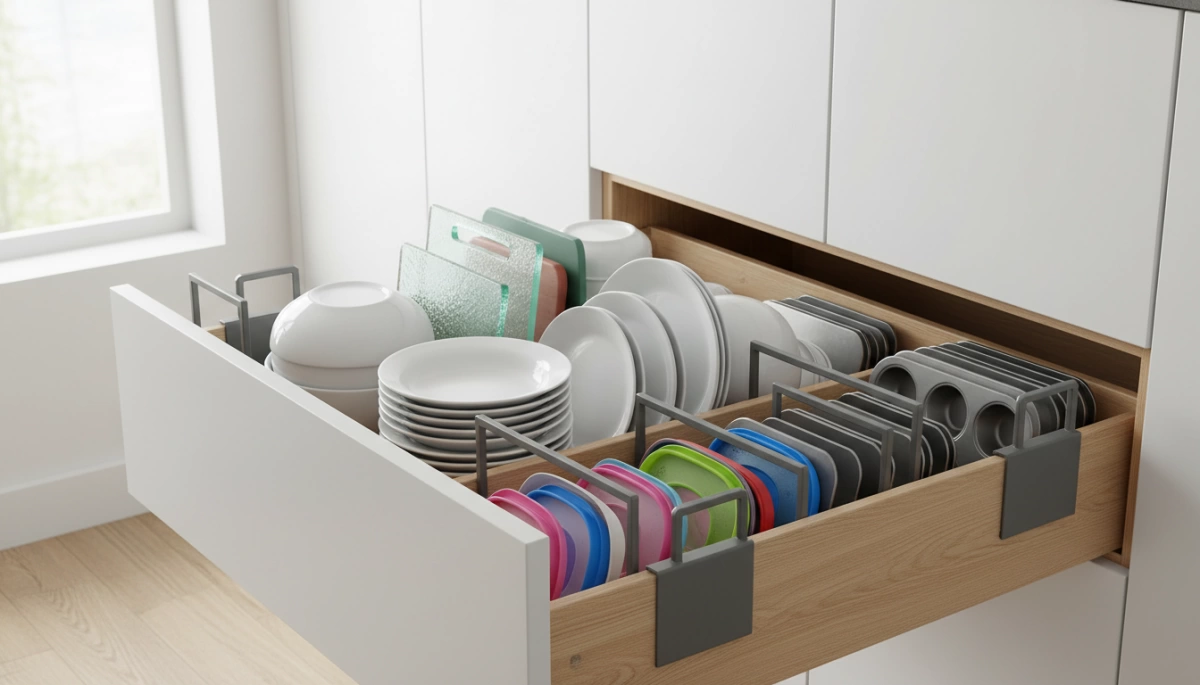
Why baking sheets need vertical storage
Flat stacking is the fastest way to create a loud, messy pile. Vertical storage:
- Keeps baking sheets, trays, and cutting boards easy to grab
- Prevents scratching and warping
- Stops that “clatter” every time you pull one pan out
If you bake even a couple times a month, vertical dividers are a game changer for a more functional kitchen.
File-style organizers for tight cabinets
For most U.S. kitchens, especially apartments, tall narrow cabinets are prime kitchen storage solutions:
- Use file-style baking sheet organizers to “stand” sheets and trays like folders
- Place near the oven for better kitchen workflow zones
- Ideal for cutting boards, pizza pans, and serving trays
Look for metal or heavy-duty plastic so they don’t tip over.
Retrofit existing cabinets with dividers
You don’t need custom cabinets to maximize kitchen space:
- Add tension rods inside a cabinet to create quick vertical slots
- Use standalone tray and cutting board storage racks that just sit on the shelf
- For homeowners, install fixed dividers with simple L-brackets and plywood
These rental-friendly kitchen organization ideas are low-commitment but high-impact.
Store racks, muffin tins, and platters upright
Vertical storage isn’t just for cookie sheets:
- Stand cooling racks, muffin tins, and baking pans in the same zone
- Group by category: sheets together, racks together, boards together
- Keep large platters upright in the back and daily-use items in front
This keeps everything visible and stops the “everything slides when I pull one thing” problem.
Cut the noise and chaos
Smart cabinet organization tips are also about peace and quiet:
- No more dragging out a whole stack to reach one pan
- Less metal-on-metal banging
- Faster cleanup because everything has a clear slot
It’s a simple upgrade that makes your kitchen feel more premium without a remodel.
Pair vertical dividers with pull-out shelves
If you want peak convenience, combine vertical storage ideas with pull-out shelves:
- Install a pull-out tray in a base cabinet
- Add vertical dividers on top so sheets and boards slide out to you
- Perfect for small kitchen organization ideas where bending and digging is annoying
This combo gives you smooth access, better organization, and a cleaner, quieter kitchen that actually works for daily American family life.
Declutter Countertops with Smart Storage Hacks
A clear counter makes any kitchen feel bigger and easier to cook in. I treat my countertops like prime real estate—only daily workhorses stay out.
Audit What Deserves Space on Your Counter
Walk your kitchen and be ruthless:
- Keep on the counter (daily use):
Coffee maker, toaster, knife block or magnetic knife strip, cooking utensils in a crock, maybe a blender if you use it most days. - Move off the counter (weekly/rare use):
Stand mixer, food processor, slow cooker, air fryer, specialty gadgets. - Completely remove:
Mail, keys, kids’ toys, decor that just collects dust.
If it doesn’t earn its spot at least once a day, it goes in a cabinet, pantry, or another room.
Use Appliance Garages for Small Kitchen Organization
Appliance garages are one of my favorite kitchen storage solutions for U.S. homes with open layouts:
- Tuck toasters, blenders, and coffee makers behind a roll-up door, flip-up door, or cabinet with an outlet inside.
- Place the garage near your main prep zone so you can use appliances without dragging cords across the kitchen.
- In rentals or small apartments, use:
- A countertop cabinet with a door as a DIY appliance garage
- A microwave cart with doors to hide appliances but keep them handy
Roll-Out Trays and Slide-Out Shelves for Small Appliances
If your counters are overloaded, move small appliances into lower cabinets with pull-out shelves:
- Install roll-out trays in base cabinets for:
- Air fryer, Instant Pot, slow cooker, rice cooker, waffle maker
- Use pull-out shelves so you can:
- Slide the appliance out, plug it in, and push it back when you’re done
- Avoid heavy lifting and digging in the back of cabinets
This is a simple, rental-friendly way to maximize kitchen space and keep counters clear.
Tiered Stands and Corner Shelves for Essentials
If you must store items on the counter, go vertical:
- Add tiered stands or corner shelves for:
- Spices, salt and pepper, cooking oil, sugar bowl, small plants
- Use a lazy Susan kitchen turntable in a corner for:
- Daily condiments and sauces
- Keep only what you cook with all the time—everything else goes in a cabinet or pantry.
Create a Coffee or Tea Station
Contain the everyday mess in one spot with a simple coffee/tea station:
- Dedicate one counter zone for:
- Coffee maker or kettle
- Mugs on under-cabinet hooks or a small mug tree
- Canisters or clear pantry bins for pods, beans, tea bags, sugar, and filters
- Use a tray to corral everything so it looks intentional, not cluttered.
This keeps the morning rush from taking over the whole kitchen.
Daily and Weekly Habits to Keep Counters Clear
Smart kitchen organization ideas only work if your habits match:
- Daily (5 minutes):
- Put away appliances after use
- Clear mail and random items to a dedicated basket or drawer
- Wipe counters so you start the next day fresh
- Weekly:
- Do a quick kitchen decluttering sweep
- Empty the “catch-all” basket and put things where they belong
- Re-home anything that migrated back onto the counter
What to Store Vertically vs Behind Doors
Use vertical storage ideas to keep what you see calm and clean:
-
Store vertically (visible but tidy):
- Utensil crocks
- Tiered stands with everyday spices
- Vertical baking sheet organizer or cutting boards in a slim spot if you don’t have cabinet space
-
Store behind doors (for a calmer look):
- Bulk pantry items in pantry storage containers
- Extra mugs, serving platters, backup appliances
- Cleaning products in under-sink organizers
When in doubt, hide it. Clear counters instantly make your kitchen feel more functional, even if you’re working with a small apartment kitchen or a busy family home.
Bonus Tips for Long-Term Kitchen Organization Success
Simple decluttering routines that stick
To keep a functional kitchen long-term, I focus on tiny habits instead of big overhauls:
- 1-minute rule: if it takes under a minute (putting spices back, wiping the counter), do it now.
- Night reset: load the dishwasher, clear the sink, and wipe counters before bed.
- Weekly 10-minute purge: grab a trash bag and remove expired food, broken tools, and random clutter.
These micro-routines make every other kitchen storage solution work better.
Seasonal kitchen resets and cleanouts
I treat my kitchen like a closet—it needs seasonal resets:
- Every 3–4 months: empty one cabinet or pantry shelf at a time, toss expired items, wipe, and reset.
- Rotate summer vs. winter tools (grill tools, baking gear) so what you use most is front and center.
- Donate duplicate pots, pans, and gadgets you didn’t touch this season.
Choose multi-functional organizers and tools
In the U.S., most of us don’t have space to waste, so I rely on items that do double duty:
- Stackable clear pantry bins that work in cabinets, fridge, or pantry.
- Adjustable drawer dividers that can move as your utensil organizers change.
- Nesting bowls and measuring cups to cut down bulk.
This is the easiest way to maximize kitchen space without constant re-buying.
Track what actually gets used
A functional kitchen design only works if you use it:
- Put a small sticky note inside a cabinet or drawer; mark what you reach for often.
- After 30–60 days, move daily-use tools to prime spots and push “almost never” items up high or out.
- If something hasn’t been used in 6–12 months and isn’t sentimental or seasonal, consider letting it go.
Small habit changes for a functional kitchen
Tiny behavior shifts are more powerful than any gadget:
- Always return items to their zone (prep, cook, clean, store).
- Run the dishwasher overnight, unload in the morning so the sink stays clear.
- Do a 2-minute counter sweep after dinner to stop clutter from building.
These habit tweaks support every other kitchen organization idea you’ve set up.
Eco-friendly kitchen storage choices
I build systems that are kind to the planet and practical in a U.S. kitchen:
- Use glass containers for pantry staples and leftovers—they’re durable, non-toxic, and look clean on shelves.
- Choose reusable bins and bags over single-use plastic.
- Repurpose sturdy jars and boxes for snack zones and pantry organization hacks.
Update your setup as your life changes
Your kitchen needs to evolve with you:
- New baby? Lower a shelf for bottles and kid-friendly snacks in clear, labeled containers.
- More home cooking? Expand your pantry storage containers and baking sheet organizer space.
- Empty nest or downsizing? Scale back duplicates and simplify your small kitchen organization ideas.
I review my setup at least once a year. When your kitchen matches your real habits, all those smart kitchen organization ideas actually stick.